The American "Progressives" were the first Fascists of the 20th century
By John Ray (M.A.; Ph.D.)
"Hayek's challenge was to argue that German Nazism was not an aberrant "right-wing" perversion growing out of the "contradictions" of capitalism. Instead, the Nazi movement had developed out of the "enlightened" and "progressive" socialist and collectivist ideas of the pre-World War I era, which many intellectuals in England and the United States had praised and propagandized for in their own countries."
This article aims to give a brief review of the ideas that Hayek was referring to in the above quotation. Note also these words: "Fascism was really the basis of the New Deal". What Ronald Reagan was referring to in 1976 when he said that will become very clear below.
-----------

The "pledge" salute in an American school, Hawaii, March, 1941. The Fascist salute is of American Leftist origin. It was first demonstrated on October 12, 1892 and was originated by Francis Bellamy -- a "Christian Socialist" who championed 'the rights of working people and the equal distribution of economic resources'. In 1891, Bellamy was forced from his Boston pulpit for his socialist sermons. The salute was not abandoned in America as an accompaniment to the Pledge of Allegiance until 1942.
"Fascism" is a term that was originally coined by the Italian dictator Mussolini to describe his adaptation of Marxism to the conditions of Italy after World War I. Lenin in Russia made somewhat different adaptations of Marxism to the conditions in Russia during the same period and his adaptations came to be called Marxism/Leninism. Mussolini stayed closer to Marx in that he felt that Italy had to go through a capitalist stage before it could reach socialism whereas Lenin attempted to push Russia straight from semi-feudalism into socialism. Mussolini's principal modification of Marxism was his rejection of the notion of class war, something that put him decisively at odds with Lenin's "Reds".
If the term "Fascism" means anything of itself it means "Groupism" -- as the fasci of Italy at the time were simply groups of political activists. The fasces of ancient Roman times were of course the bundles of rods carried by the lictors to symbolize the great strength of the organized Roman people. The idea again was that people were stronger in groups than as individuals.
Mussolini's ideas and system were very influential and he had many imitators -- not the least of which was Adolf Hitler -- and some even survived World War II -- such as Peron and Chiang Kai Shek. I have set out at length elsewhere what Mussolini's Italian Fascism was all about so I will simply summarize here by saying that Fascism was a nationalist form of extreme socialism whereas Trotskyism was/is a internationalist form of extreme socialism -- with Leninism being somewhere in between.
So was Mussolini a totally original thinker? Not at all. Students of ancient history see Sparta as the first Fascist State and students of Marx identify Fascism with "Bonapartism" (See Appendix 3 below) -- the type of regime devised by Napoleon Bonaparte and revived by his nephew Napoleon III. But Mussolini was quite intellectual and his thinking was in fact much more up-to-date than that would suggest. He was certainly influenced by Marx and the ancient world but he had a whole range of ideas that extended beyond that. And where did he turn for up-to-date ideas? To America, of course! And the American ideas that influenced him were in fact hard to miss. They were the ideas of the American "Progressives". And who was the best known Progressive in the world at that time? None other than the President of the United States -- Woodrow Wilson -- the man who was most responsible for the postwar order in Europe. So Mussolini had to do little more than read his newspapers to hear at least some things about the ideas of the very influential American Progressives. And who were the Progressives? Here is one summary of them:
"Originally, progressive reformers sought to regulate irresponsible corporate monopoly, safeguarding consumers and labor from the excesses of the profit motive. Furthermore, they desired to correct the evils and inequities created by rapid and uncontrolled urbanization. Progressivism ..... asserted that the social order could and must be improved..... Some historians, like Richard Hofstadter and George Mowry, have argued that the progressive movement attempted to return America to an older, more simple, agrarian lifestyle. For a few progressives, this certainly was true. But for most, a humanitarian doctrine of social progress motivated the reforming spirit"
The summary of Progressivism above is from De Corte (1978). Against all his own evidence, De Corte also claims that the Progressives were "conservative". Why? Because there was something else about the Progressives that profoundly embarrasses both De Corte and all modern Leftists: The Progressives were keen eugenicists. So DeCorte tries to evade that. See here and here and also Pickens (1968) for the Leftist committment to eugenics prior to World War II. The following quotation, however, gives the highly racist basis for "Progressive" thinking on the matter:
"Into the scarcity thus created in particular districts, in particular sections of the labour market, or in particular social strata, there rush the offspring of the less thrifty, the less intellectual, the less foreseeing of races and classes - the unskilled casual labourers of our great cities, the races of Eastern or Southern Europe, the negroes, the Chinese - possibly resulting, as already in parts of the USA, in such a heterogeneous and mongrel population that democratic self-government, or even the effective application of the policy of a national minimum of civilised life, will become increasingly unattainable.
If anything like this happens, it is difficult to avoid the melancholy conclusion that, in some cataclysm that it is impossible for us to foresee, that civilisation characteristic of the Western European races may go the way of half a dozen other civilisations that have within historic times preceded it; to be succeeded by a new social order developed by one or other of the coloured races, the negro, the kaffir or the Chinese"
Excerpt from "Fabians" Sidney and Beatrice Webb – from their article "The Great Alternative", New Statesman, 20/8/1913 (Quoted in 'Fabianism and Colonialism' by Francis Lee).
And that great "progressive" at the beginning of the 20th century -- Theodore Roosevelt -- had nothing to learn from Hitler when it came to the racist barbarity with which he treated the Philippinos
Here is a brief summary of the "Progressive" era from a non-Leftist perspective:
"The Progressive Era is a period of one big lie after another, crafted upon the false belief that modern government somehow could replace a free market, private property order and create an economy marked both by prosperity and "fairness." From "scientific" management to "enlightened" religion (called theological liberalism and, later, secularism) to Prohibition to "objective" journalism, the belief was that modern society had found the key to "onward and upward" progress."
And a scholarly summary can be found here in a book review of David W. Southern's book on the Progressive era. The following may be a useful excerpt:
The Progressive movement swept America from roughly the early 1890s through the early 1920s, producing a broad popular consensus that government should be the primary agent of social change. To that end, legions of idealistic young crusaders, operating at the local, state, and federal levels, seized and wielded sweeping new powers and enacted a mountain of new legislation, including minimum wage and maximum hour laws, antitrust statutes, restrictions on the sale and consumption of alcohol, appropriations for hundreds of miles of roads and highways, assistance to new immigrants and the poor, women's suffrage, and electoral reform, among much else....
Yet the Progressive Era was also a time of vicious, state-sponsored racism. In fact, from the standpoint of African-American history, the Progressive Era qualifies as arguably the single worst period since Emancipation. The wholesale disfranchisement of Southern black voters occurred during these years, as did the rise and triumph of Jim Crow. Furthermore, as the Westminster College historian David W. Southern notes in his recent book, The Progressive Era and Race: Reform and Reaction, 1900-1917, the very worst of it-disfranchisement, segregation, race baiting, lynching-"went hand-in-hand with the most advanced forms of southern progressivism." Racism was the norm, not the exception, among the very crusaders romanticized by today's activist left.
At the heart of Southern's flawed but useful study is a deceptively simple question: How did reformers infused with lofty ideals embrace such abominable bigotry? His answer begins with the race-based pseudoscience that dominated educated opinion at the turn of the 20th century. "At college," Southern notes, "budding progressives not only read exposes of capitalistic barons and attacks on laissez-faire economics by muckraking journalists, they also read racist tracts that drew on the latest anthropology, biology, psychology, sociology, eugenics, and medical science."
And as this article shows, the American "Progressives" of the late 19th and early 20th century were not only Leftists but they were also war-glorifying militarists. Hitler got not only his eugenic ideas from American Leftists but even his ideas about war being a purification of the national spirit etc. And who was it who said this?
"Conformity will be the only virtue and any man who refuses to conform will have to pay the penalty."
Was it Adolf? It sounds very much like either Adolf or Mussolini at the height of their powers but it was in fact said while both Hitler and Mussolini were still in the trenches of World War I and it was said by the President of the United States, the arch-Progressive Woodrow Wilson. See here for that and many other ways (including book-burning) in which Adolf learnt from American leftists. History can be very surprising. Loberfeld's short history of progressivism has more on its militaristic aspects.
Wilson even foreshadowed Hitler's racism. Note this quote about his actions in 1912:
"Upon taking power in Washington, Wilson and the many other Southerners he brought into his cabinet were disturbed at the way the federal government went about its own business. One legacy of post-Civil War Republican ascendancy was that Washington's large black populace had access to federal jobs, and worked with whites in largely integrated circumstances. Wilson's cabinet put an end to that, bringing Jim Crow to Washington. Wilson allowed various officials to segregate the toilets, cafeterias, and work areas of their departments".
So Wilson actually reversed more tolerant policies put in place by Republicans. Racism was very LEFTIST in Hitler's day. Leftists like to portray Wilson as a visionary. They neglect to mention that the future he envisioned was a racially segregated one.
Jonah Goldberg has a good summary of the Wilson administration too:
Under Woodrow Wilson, the first American president to embrace the new cult of pragmatism and power that had overtaken “enlightened” thinkers on both sides of the Atlantic (and the first American president to openly disdain the U.S. Constitution), the progressives unleashed a crackdown on freedom that makes the supposed fascism of the McCarthy era and the Bush years seem like a teach-in at Smith College. Wilson established the American Protective League, a group of domestic fascisti charged with crushing dissent, beating “slackers,” and intimidating average Americans. Wilson’s Committee for Public Information was the first modern propaganda ministry. Indeed, according to the late sociologist and intellectual historian Robert Nisbet, the “West’s first real experience with totalitarianism — political absolutism extended into every possible area of culture and society, education, religion, industry, the arts, local community and family included, with a kind of terror always waiting in the wings — came with the American war state under Wilson.”
And I suppose it is very crass and inconsiderate of me to point out that Wilson began his book: The State. Elements of Historical and Practical Politics: A sketch of institutional History and Administration with a study of Aryan politics. Woody's book does not appear to be available anywhere online so I have reproduced in an Appendix to this article some extracts from it about Aryans and such matters.
At the risk of appearing to flog a dead horse, I might also point to Koenigsberg's demonstration that Hitler saw Germany as a living organism that was severely threatened. And where did Hitler get the idea of Germany as a biological organism? He could have got it from various sources but one of the most prominent sources of such thinking was again the very anti-business Woodrow Wilson -- who justified his wish to scrap the checks and balances of the American constitution on the grounds that the U.S. government was "not a machine, but a living thing. It falls, not under the theory of the universe, but under the theory of organic life... No living thing can have its organs offset against each other, as checks, and live". And American Leftists still often characterize the constitution as a "living" thing to this day. Like Wilson, they use such language as an excuse for escaping the constraint of law that does not suit them. Hitler would have seen that as perfectly proper!
In fact, the more one reads about the American "Progressives" of the late 19th and early 20th centuries, the more parallels one finds between them and the Fascists. For instance, particularly prominent on the American Left were the Bellamys. Edward and Francis Bellamy actively promoted what they called "military socialism" and, largely under their influence, loyalty oaths, flag ceremonies, racist preaching and even the straight-armed salute were all common in America long before they were adopted by Mussolini and the Nazis. See here for some details, including remarkable photographs from the period concerned.
And the now notorious Ku Klux Klan was another of those parallels. It was once quite respectable in "Progressive" circles. There is a very good article here spelling out how much the prewar KKK had in common with the "Progressives" of that era. Many of the things that the KKK stood for don't sound Leftist today but they were Leftist in the heyday of the Klan. As already mentioned, even overt racism was "progressive" in the first half of the 20th century. Excerpt:
"In fact, the 1924 election indicates the extent to which the Klan was entangled with the progressives. For that was the year of the Democrats' infamous "klanbake" convention, when Klansmen participated heavily as delegates and blocked a platform plank that would have condemned their order. They also entered the presidential race ... they endorsed the Californian William McAdoo, son-in-law to the late President Wilson...... What were the man's most notable accomplishments? He had been one of the architects of Wilson's war collectivism, helping create the Council of National Defense and serving as head of the Railroad Administration. And as secretary of the treasury, he had been instrumental in creating one of the Progressive Era's most substantial new interventions in the economy: the Federal Reserve system".
And are feminists conservative? Hardly. And feminists are hardly a new phenomenon either. Feminism too was part of "Progressive" thinking. In the person of Margaret Sanger and others, feminists were very active in the USA in first half of the 20th century, advocating (for instance) abortion. And Margaret Sanger was warmly praised by Hitler for her energetic championship of eugenics. And the American eugenicists were very racist. They shared Hitler's view that Jews were genetically inferior and opposed moves to allow into the USA Jews fleeing from Hitler (See here and Richmond, 1998). So if Hitler's eugenics and racial theories were loathsome, it should be acknowledged that his vigorous supporters in the matter at that time were Leftists and feminists, rather than conservatives.
And another thing that identifies Hitler more with the American Left than the Right of his day: Jim Lindgren has extracted some data from a U.S. Gallup poll taken in 1938. It showed that the support for an anti-Jewish campaign was quite low in America but that Democrat voters were 50% more likely to support such a campaign than were Republicans (14.7% versus 9.8%). Again we see that Hitler's friends in America were primarily on the Left.
The relatively low level of antisemitism among Americans at that time was not the fault of the outspoken Leftists of the day, however. For instance, we read of the populist and influential Father Coughlin:
As the Great Depression dragged toward the end of its first decade in 1938, Father Charles Coughlin released the latest issue of his newspaper Social Justice. It reprinted that most notorious and persistent of anti-Semitic tracts, The Protocols of the Learned Elders of Zion. Coughlin's decision to disseminate the spurious conspiracy tale to his millions of followers was not just the same old Jew-hatred, even if part of his financing came from Henry Ford. It marked Coughlin's transformation from an ardent New Dealer, who had coined the phrase "Roosevelt or Ruin," to a divisive demagogue. The through-line from Coughlin the social democrat to Coughlin the biased provocateur was populism. The same ideology that had led him earlier in his public career to attack corporate power and unmediated capitalism, to champion labor unions and activist government, also enabled him to search for a scapegoat.
The above was written by a modern-day Leftist and so pretends that antisemitism was a departure from the Leftist "New Deal" ideas of FDR but we will see to the contrary below. Coughlin did fall out with FDR but only because FDR was not Leftist enough for him!
But to return to Mussolini for a moment: Where do you think he got these ideas in a speech he made in 1933?
"If we are to go forward we must move as a trained and loyal army willing to sacrifice for the good of a common discipline, because, without such discipline, no progress is made, no leadership becomes effective. We are, I know, ready and willing to submit our lives and property to such discipline because it makes possible a leadership which aims at a larger good".
It's mainstream Fascism, isn't it? Totally submerging the individual into an army that works only for the common good rather than individual good. The trouble is that it was not a speech made by Mussolini. It is an excerpt from the First Inaugural Address of Franklin Delano Roosevelt -- great hero of the American Left to this day. So the ideas of the "Progressives" were also the ideas of FDR's "New Deal". Leftism has gone under many names but the basic desire to reduce people to an antlike status remains. Read the above quote again if you doubt it. Or read Hegel for that matter (see Appendix 2 below). And see Trifkovic for more detail on the affinities between FDR and Mussolini.
And, like Wilson, FDR did nothing to disappoint the racists of his day. Note this quote showing that FDR too was a typical (racist) Leftist of his era:
"For an excellent illustration of just how little FDR cared for the desperate plight of southern blacks, you can study what happened to the Scottsboro Boys, eight young black men unjustly accused of raping two white women in 1931 Alabama. Even the more level-headed Southerners eventually came to see that no rapes had occurred and that the accused were innocent. But given the region's fierce pride, untangling the legal mess created by their conviction took many years. FDR could have waved it all away with a single signature on a federal pardon, knowing that the party's southern leadership would see that it never became a political issue. Instead, he did nothing."
And it was of course FDR who sent the desperate German Jewish refugees aboard the "St. Louis" back to Germany in 1939 -- despite the low level of antisemitism in America at that time.
And that is not the end of the affinities between F.D. Roosevelt and the European Fascists. As Hornberger reminds us:
"Were Hitler's economic policies in the 1930s, however, significantly different from those of Roosevelt, his counterpart in the United States? On the contrary, there was a striking similarity between FDR's New Deal and the methods that Hitler used to get Germany out of the Depression. Both FDR and Hitler instituted massive government spending campaigns, including public-works programs, to bring full employment to their countries. In the United States, for example, there was the Hoover Dam. In Germany, there was the national autobahn system.
The Nazis also imposed an extensive system of governmental control over German businesses. Was Roosevelt's approach any different? Consider FDR's pride and joy, his National Recovery Act, which was characterized by the infamous Blue Eagle. With the NRA, the U.S. government required entire industries to combine into government-protected cartels, and directed them to fix wages and prices in their respective industries. If a businessman refused to go along, he faced prosecution and punishment, not to mention protest demonstrations from Blue Eagle supporters. (The Supreme Court ultimately declared the NRA unconstitutional.)
Let's also not forget the important paternalistic elements of Hitler's national socialism: Social Security, national health care, public schooling, and unemployment compensation. Sound familiar?
Hitler himself showed keen insight into this matter. In his biography Adolf Hitler, John Toland writes, "Hitler had genuine admiration for the decisive manner in which the President had taken over the reins of government. 'I have sympathy for Mr. Roosevelt,' he told a correspondent for the New York Times two months later, 'because he marches straight toward his objectives over Congress, lobbies and bureaucracy.' Hitler went on to note that he was the sole leader in Europe who expressed 'understanding of the methods and motives of President Roosevelt.'"
So again we see European Fascists learning from and admiring the dominant American Leftists of their day. They were brothers in arms, just as Hitler and Stalin were later literally brothers in arms. That brothers sometimes fall out should not prevent us from noting the brotherhood concerned. Note it below from a prewar source:
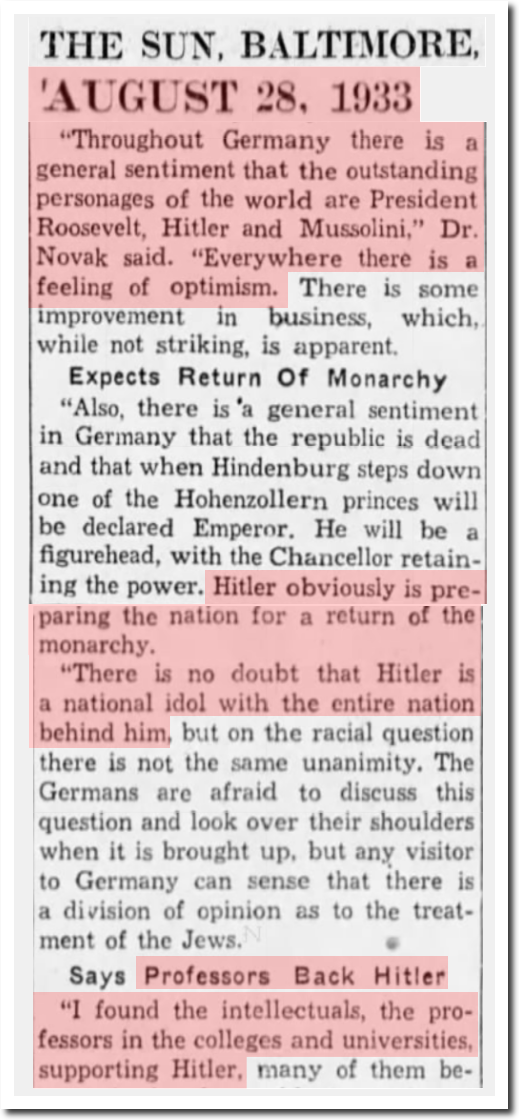
FDR is a tempting topic to continue with, so widely is he misrepresented and beatified, so I will say just a little more about the history of his times. That history is well encapsulated in the book Three New Deals: Reflections on Roosevelt's America, Mussolini's Italy, and Hitler's Germany, 1933-1939. By Wolfgang Schivelbusch. Some excerpts from a review of the book:
"Critics of Roosevelt's New Deal often liken it to fascism. Roosevelt's numerous defenders dismiss this charge as reactionary propaganda; but as Wolfgang Schivelbusch makes clear, it is perfectly true. Moreover, it was recognized to be true during the 1930s, by the New Deal's supporters as well as its opponents.....
The Nazi press enthusiastically hailed the early New Deal measures: America, like the Reich, had decisively broken with the "uninhibited frenzy of market speculation." The Nazi Party newspaper, the Voelkischer Beobachter, "stressed 'Roosevelt's adoption of National Socialist strains of thought in his economic and social policies,' praising the president's style of leadership as being compatible with Hitler's own dictatorial Fuehrerprinzip" (p. 190).
Nor was Hitler himself lacking in praise for his American counterpart. He "told American ambassador William Dodd that he was 'in accord with the President in the view that the virtue of duty, readiness for sacrifice, and discipline should dominate the entire people. These moral demands which the President places before every individual citizen of the United States are also the quintessence of the German state philosophy, which finds its expression in the slogan "The Public Weal Transcends the Interest of the Individual"'" (pp. 19-20). A New Order in both countries had replaced an antiquated emphasis on rights.
Mussolini, who did not allow his work as dictator to interrupt his prolific journalism, wrote a glowing review of Roosevelt's Looking Forward. He found "reminiscent of fascism … the principle that the state no longer leaves the economy to its own devices"; and, in another review, this time of Henry Wallace's New Frontiers, Il Duce found the Secretary of Agriculture's program similar to his own corporativism (pp. 23-24).
If what I have so far written has not totally demolished the FDR myth, see here, here, here and here.
And I can hardly leave the subject without mentioning FDR's imprisonment of almost all people of Japanese descent living in the USA after the attack on Pearl Harbour by the Empire of Japan. This totally Fascistic contempt for individual liberties is well-known and fortunately still attracts some controversy. But there was little opposition to it at the time. "Progressive" thinking was very dominant in American politics in the first half of the 20th. century. One State governor salvages some self-respect for America over it, however: Colorado governor Carr:
"On Feb. 19, 1942, then-Gov. Carr was fuming. He yelled at his staff even though they were not the object of his scorn, but since he did not have direct access to the White House and President Franklin Delano Roosevelt, they'd have to do. Clutching Executive Order 9066 in his hand, he paced and shouted, "What kind of a man would put this out?"
The president's order allowed for the de facto declaration of martial law on the West Coast with one not-so-veiled purpose: to remove anyone of Japanese descent. It was soon after Japan's attack on Pearl Harbor, which killed thousands of Americans. The Japanese were called "yellow devils" on the front page of papers like The Denver Post. People clamored for them to be locked up, sent to work camps, or - in the words of one Colorado farmer - "just killed." No one distinguished between non-citizen and citizen. No one talked about constitutional rights. No one except for Ralph Carr.
"Now, that's wrong," Carr told his staff. "Some of these Japanese are citizens of the United States. They're American citizens." And yet, nearly 120,000 people of Japanese descent, many of them American citizens, would spend the war years in internment camps, including Camp Amache, located near Granada in southeast Colorado. Barbed wire lined their boundaries and military police guarded their exits.
Carr would share his message with Colorado. He said we must protect the Constitution's principles for "every man or we shall not have it to protect any man." Further, he said, if we imprison American citizens without evidence or trial, what's to say six months from now, we wouldn't follow them into that same prison without evidence or trial? The Constitution, he said, starts with, " 'We the people of the United States.' It doesn't say, 'We the people, who are descendants of the English or the Scandinavians or the French.'"
Governor Carr was a Republican.
A remaining issue is the nationalistic and imperialistic nature of Mussolini's Fascism and Hitler's Nazism. Was that prefigured in the American Progressives too? Yes. Unlike the American Leftists of today, the Progressives were in fact thoroughly patriotic, and Croly -- arguably the leading light of Progressivism -- was certainly explicitly nationalist. And one of Croly's disciples was both vastly influential and a remarkably exact model for Mussolini's imperialistic nationalism. The disciple concerned? Yet another American President: Theodore Roosevelt. To know anything of American history of the early 20th century is to know of TR's strident American nationalism and militarism and his key role in the conquest of the Spanish empire in Cuba and the Philippines on quite shallow pretexts.
TR did of course start out as a Republican but he later broke with the Republicans and formed -- wait for it: The Progressive party (better known by its nickname: The Bull Moose Party). From very early-on, however, he was reform-minded and anti-big-business. And even whilst a Republican President he was notable for his worker-welfare and environmentalist initiatives -- setting up national parks in particular. And in good Progressive fashion he stretched his Presidential authority to the limit in some of those initiatives. At the risk of stating the obvious, it must be noted that it is only in very recent times that the two major American political parties have become clearly delineated as Leftist and Rightist and so the Progressives were an influence that could and did operate within both major parties of that time. And before his break with the Republicans it was the progressive wing of the Republican party that TR was identified with. But certainly in war-glorifying, militaristic, nationalistic, action-worshipping and big-government ideas TR very strongly anticipated Mussolini. And TR, of course, "entirely" agreed that as a race negroes are "altogether inferior to the whites." There is a good article on Progressivism generally which shows how profoundly Leftist TR was here.
And the following description of American Progressivism in the early 20th century could just as well have been a description of Fascism:
"Progressive policies embodied an underlying philosophy repugnant to Jeffersonianism. As Ekirch describes this philosophy, "Society in the future would have to be based more and more on an explicit subordination of the individual to a collectivist, or nationalized, political and social order. This change, generally explained as one of progress and reform, was of course also highly important in building up nationalistic sentiment. At the same time, the rising authority and prestige of the state served to weaken the vestiges of internationalism and cosmopolitanism and to intensify the growing imperialistic rivalries." In their statist cause the progressives, who were now appropriating the name "liberal," enlisted Social Darwinism, economic determinism, and relativism.
So 20th century Fascism was in fact an American invention, or more precisely an invention of the American Left. Like many American ideas to this day, however, it proved immensely popular in Europe and it was only in Europe that it was put fully into practice. As it does today, American conservatism kept the American Left in some check in the first half of the 20th century so it was only in Europe that their ideas could come into full bloom.
And when those ideas did come into full bloom, America's "progressive" intelligentsia warmly welcomed them of course. And that great present-day friend of Leftist extremism -- Harvard University -- was in the lead. Below is just one small extract from the history of the times:
"The Harvard University administration during the 1930s, led by President James Conant, ignored numerous opportunities to take a principled stand against the Hitler regime and the antisemitic outrages it perpetrated, and contributed to Nazi Germany's efforts to improve its image in the West. The administration's lack of concern about Nazi antisemitism was shared by many influential Harvard alumni and students. A faculty panel that supervised a mock trial of Hitler in 1934 ruled that Hitler's anti-Jewish actions were "irrelevant" to the debate. Nazi leaders were warmly welcomed to the Harvard campus and invited to prestigious social events, as the Harvard administration strove to build friendly relations with thoroughly Nazified universities in Germany. By doing so, Harvard's administration and many of its student leaders offered important encouragement to the Hitler regime as it intensified its persecution of the Jews and strengthened its armed forces.....
Prominent Harvard alumni, student leaders, and some faculty assumed a major role in the friendly welcome accorded the Nazi warship Karlsruhe when it visited Boston in 1934, flying the swastika flag. Boston's Jewish community protested vociferously. President Conant remained silent. Officers and crewmen from the warship were entertained at Harvard, and professors attended a gala reception in Boston where the warship's captain enthusiastically praised Hitler.
That year, the Harvard administration welcomed a top Nazi official, Ernst Hanfstangl, who was Hitler's foreign press chief as well as a virulent antisemite, to the campus for his 25th class reunion. The student newspaper, the Harvard Crimson, editorialized that the university should award Hanfstangl an honorary degree "as a mark of honor appropriate to his high position in the government of a friendly country." The joyous reception Hanfstangl received on campus was interrupted when a local rabbi confronted him and demanded to know what Hanfstangl had meant when he recently remarked that "everything would soon be settled for the Jews in Germany." The rabbi cried out, "My people want to know . . . does it mean extermination?" Hanfstangl replied that he "[could] not discuss that. I am on vacation. I am with my old friends." The Nazi official proceeded to President Conant's house for tea.
Anti-Nazi activists opposed Hanfstangl's visit. Some put up posters in Harvard Yard, only to have the Harvard police tear them down. Others held a rally in Harvard Square. Seven demonstrators who tried to speak at the rally were arrested, and sentenced to six months at hard labor. Conant called the demonstration "very ridiculous."
So where did the Progressives get their ideas? Did they invent their ideas out of the blue? Of course not. Right up until World War I it was popular and even fashionable for American intellectuals to study in Germany -- where the thought of Hegel was very influential. And many of the Progressives were included in that movement. Let us look at a few quotes from some of the Hegelian thinkers of 19th century Germany:
"Among all the nations and sub-nations of Austria, only three standard-bearers of progress took an active part in history, and are still capable of life -- the Germans, the Poles and the Magyars. Hence they are now revolutionary. All the other large and small nationalities and peoples are destined to perish before long in the revolutionary world storm.... This remnant of a nation that was, as Hegel says, suppressed and held in bondage in the course of history, this human trash, becomes every time -- and remains so until their complete obliteration or loss of national identity -- the fanatical carriers of counter-revolution, just as their whole existence in general is itself a protest against a great historical revolution.... Such, in Austria, are the pan-Slavist Southern Slavs, who are nothing but the human trash of peoples, resulting from an extremely confused thousand years of development.... The next world war will result in the disappearance from the face of the earth not only of reactionary classes and dynasties, but also of entire reactionary peoples. And that, too, is progress"
"By the same right under which France took Flanders, Lorraine and Alsace, and will sooner or later take Belgium -- by that same right Germany takes over Schleswig; it is the right of civilization as against barbarism, of progress as against stability. Even if the agreements were in Denmark's favor -- which is very doubtful-this right carries more weight than all the agreements, for it is the right of historical evolution"
"Feuerbach starts out from the fact of religious self-alienation, of the duplication of the world into a religious world and a secular one. His work consists in resolving the religious world into its secular basis. But that the secular basis detaches itself from itself and establishes itself as an independent realm in the clouds can only be explained by the cleavages and self-contradictions within this secular basis. The latter must, therefore, in itself be both understood in its contradiction and revolutionized in practice. Thus, for instance, after the earthly family is discovered to be the secret of the holy family, the former must then itself be annihilated in theory and in practice."
"The French Revolution was the rise of democracy in Europe. Democracy is, as I take all forms of government to be, a contradiction in itself, an untruth, nothing but hypocrisy (theology, as we Germans call it), at the bottom. Political liberty is sham-liberty, the worst possible sort of slavery; the appearance of liberty, and therefore the worst servitude. Just so also is political equality for me; therefore democracy, as well as every other form of government, must ultimately break to pieces"
"True, it is a fixed idea with the French that the Rhine is their property, but to this arrogant demand the only reply worthy of the German nation is Arndt's: "Give back Alsace and Lorraine". For I am of the opinion, perhaps in contrast to many whose standpoint I share in other respects, that the reconquest of the German-speaking left bank of the Rhine is a matter of national honour, and that the Germanisation of a disloyal Holland and of Belgium is a political necessity for us. Shall we let the German nationality be completely suppressed in these countries, while the Slavs are rising ever more powerfully in the East?"
"Let us consider the actual, worldly Jew -- not the Sabbath Jew, as Bauer does, but the everyday Jew. Let us not look for the secret of the Jew in his religion, but let us look for the secret of his religion in the real Jew. What is the secular basis of Judaism? Practical need, self-interest. What is the worldly religion of the Jew? Huckstering. What is his worldly God? Money. Very well then! Emancipation from huckstering and money, consequently from practical, real Jewry, would be the self-emancipation of our time.... We recognize in Jewry, therefore, a general present-time-oriented anti-social element, an element which through historical development -- to which in this harmful respect the Jews have zealously contributed -- has been brought to its present high level, at which it must necessarily dissolve itself. In the final analysis, the emancipation of the Jews is the emancipation of mankind from Jewry".
The similarities to Hitler's thought stand out, do they not? So who wrote the above quotes? All of them are from either Karl Marx or Friedrich Engels. See Marx & Friends. So although the American Progressives developed most of the thought that we would recognize as Fascist today, their immediate predecessors were undisputably German. So while Mussolini got his basic ideas from Marx and Marx got them from Hegel, the work of developing those ideas and adapting them to the early 20th century had mostly already been done for him by the Americans. I say something about Hegel himself in an Appendix to this article.
And let's look at the views of a great Marxist hero -- one who is, like Castro, much admired and defended by most American "liberals" to this day:
"Salvador Allende, the socialist president of Chile who was killed during a CIA-backed coup in 1973, was an anti-Semite who held fascist ideas in his youth, says a new book which has split Chile. The book, Salvador Allende: Antisemitism and Euthanasia, will shock those around the world who revere the late president as a socialist martyr..... The disclosures come from Allende's 1933 doctoral dissertation which had been kept secret. In it he asserts that Jews have a disposition to crime, and calls for compulsory sterilisation of the mentally ill and alcoholics. Victor Farias, the book's Chilean-born author, said Allende quotes approvingly a "cure" for homosexuality, which was then a crime: "It could be corrected with surgery - small holes would be made in the stomach, into which small pieces of testicle would be inserted. This would make the person heterosexual.""
Charming chap!
So however you look at it, the connection of Fascism to Leftism is quite seamless. Its origins were in the intellectuals of the 19th century German Left, it was developed and made politically influential by the American Left around the beginning of the 20th century and it reached its full implementation in the hands of one section of the European Left in the 1920s and 1930's -- i.e. Hitler & Mussolini. And both Hitler and Mussolini campaigned as socialists and never ceased advocating socialism. See here and here for more on the latter point.
Because they are so embarrassing to the Left of today, there are always attempts to deny that the American Progressives of a century ago were Leftists. Attempts are made to treat them as somehow outside the normal flow of history -- as a strange aberration that somehow exists all by itself. This is absurd on two grounds: 1). Far from being a marginal group the Progressives were in the mainstream of American intellectual life at the time -- with only the courts and the conservative wings of the political parties standing against them. 2). Although the militarism, imperialism, racism and stress on discipline may seem abhorrent to the American Left of today, such ideas were perfectly at home even within the thought of Marx and Engels. And if Marx and Engels are not Leftists, who would be?
For deep background on the American Progressives see this essay on Croly, one of the leading lights of Progressivism. Note the agony caused to Croly by the need to keep within democracy. And for full coverage of the "forgotten" fact that it was up until recently the Democratic party that was America's fountainhead of racism, see Wrong on Race by Bruce Bartlett.
There is a bit more about the thinking of the "Progressives" here (or here)
REFERENCES
Pickens, D. (1968) Eugenics and the Progressives. Nashville: Vanderbilt University Press
Richmond, M. (1998) Margaret Sanger's eugenics. See here or here.
APPENDICES
(1). THE SOCIAL CLASS BASIS OF FASCISM
Despite all the similarities between American and European Fascism outlined above there is one way in which the two differed markedly. And -- most amusingly -- they differed in exactly the opposite way to what is most usually claimed. The normal claim by Marxists in particular is that Fascism was "middle class". And it clearly was -- but in America only. "Progressivism" in America was very definitely the ruling ideology among American intellectuals of the early 20th century. But that was not true in Europe. In both Italy and Germany it was a mass movement as strongly rooted in the working class as anywhere else.
For a summary of the evidence about the alleged class-basis of German Nazism and Italian Fascism, see here
(2). HEGEL: Intellectual father of Marx, Engels, Hitler, Wilson etc.
Marx, Engels and Hitler were all Hegel devotees, the former two most particularly so. Hegel is VERY heavy going but he seems to have had practically all of the many second-rate 19th century German and American thinkers enraptured so it seems important to get at least some idea of what he was on about. The excerpt below is from an essay called "The Nature of Spirit". And I have highlighted in red what I think are the most significant phrases:
"We have considered subjective volition where it has an object which is the truth and essence of a reality, viz. where it constitutes a great world-historical passion. As a subjective will, occupied with limited passions, it is dependent, and can gratify its desires only within the limits of this dependence. But the subjective will has also a substantial life -- a reality, -- in which it moves in the region of essential being, and has the essential itself as the object of its existence. This essential being is the union of the subjective with the rational will: it is the moral whole, the state, which is that form of reality in which the individual has and enjoys his freedom; but on the condition of his recognizing, believing in and willing that which is common to the whole. And this must not be understood as if the subjective will of the social unit attained its gratification and enjoyment through that common will; as if this were a means provided for its benefit; as if the individual, in his relations to other individuals, thus limited his freedom, in order that this universal limitation -- the mutual constraint of all -- might secure a small space of liberty for each. Rather, we affirm, are law, morality, government, and they alone, the positive reality and completion of freedom. Freedom of a low and limited order, is mere caprice; which finds its exercise in the sphere of particular and limited desires.
Aaaargh! Is that what you are saying? I don't blame you. Anyone used to Anglo-Saxon ideals of making things clear should gag on that lot. I hope the red bits helped, anyway. So let me try to sum up in plain words what Hegel is on about. Very cheeky of me to think I can do that in just a few paragraphs but we Anglo-Saxon analytical philosophers are a disrespectful lot.
Hegel's basic idea -- and the idea that absolutely GRABBED Marx, Engels and Hitler -- was that history is ORDERLY -- rather than just repeating itself, it is actually a progression towards an endpoint of perfection. And that perfect end is freedom -- but not freedom as we would know it. And history somehow also has a spirit -- in a way that makes sense only to German philosophers as far as I can see. So M, E & H all thought they saw the perfection of human history gradually unfolding before their eyes and wanted to give it a kick along. And they were greatly motivated by Hegel's view that some people and events are of "world-historical" significance. Anybody reading my MarxWords blog will have noticed that phrase cropping up in the writings of Marx and Engels and, as you can see from the excerpt above, the phrase comes from Hegel. In other words, some people and events are major influences in giving history a kick along in its journey towards its ultimate end. And guess who wanted to be counted among those "world-historical" figures? Our old friends M, E and H, of course. Being a world-historical figure would have to be the ultimate ego-trip.
So you also see where Marx's theory of historical stages comes from. It is just an attempt to firm up Hegel's basic idea.
And you also note what an Orwellian view of freedom Hegel had. THE STATE is the essential reality and embodies all of human progress. And we are free only when we are all merged into a common will within the State. So the ultimate freedom is the freedom of the ant -- freedom to march happily and voluntarily in lockstep with everybody else. Any other freedom is "of a low and limited order" and "mere caprice".
Horrific? Maybe to most people reading this but the political Left of today still seems to have that ideal. That is where the political correctness movement seems to be marching off towards -- a total uniformity of thought and speech where nobody is "offended" and everybody lives by "enlightened" rules.
And you can also see the foundation for the ideas that Hitler, Mussolini and Lenin had about the supremacy of the State over the individual. And hopefully, seeing how those particular States ended up warns us of how dangerous Hegel's seemingly obscure ideas in fact are.
And the revered Woodrow Wilson was an Hegelian too. As we read in this summary of a very large study of Wilson's writings:
"Wilson set forth his theory of government in numerous academic writings (compiled by Pestritto in his companion volume), in which his debt to foreign thinkers is clearly evident, not only in his use of sources but in the arguments themselves. Pestritto's discussion of these philosophical themes is lucid and helpful. Here one finds traces of both Hegel and the social Darwinism that suffused so many of the writings of that period. Wilson accepts the Hegelian notion that progress occurs through struggle and conflict, and shifts seamlessly into a social Darwinian discourse about superior races. (Although Pestritto rejects the usual interpretation that Wilson was "merely" a Southern racist, preferring to attribute his racism to more heady sources, it is not clear why Wilson's prejudice against blacks must be an either/or matter.)
Again following Hegel, Wilson rejected social compact theory as too abstract, despite the evidence that this was in fact how the American republic was established (and, we can add, the prevailing model of what constitutes legitimacy in today's world). Nor did he show any sympathy for the idea that the so-called state of nature reflects an insight about the moral primacy of the individual or the legitimate purposes of government. For Wilson, it was not the rights-bearing individual who matters but the society as a whole. Accordingly, he rejected the founders' idea that free government must seek to enlist the interests and passions, as well as the opinions, of each individual. For Wilson, the appeal to self-interest clearly marked a more primitive era, which history had left behind. Disinterestedness, directed toward the common good, was now the higher moral calling, and individual rights should no longer be permitted to serve as a barrier to the achievement of the ethical state. This was true especially for property rights, which Wilson regarded as historically contingent. He dismissed the founders' claim that in a popular government, majority tyranny remains a permanent danger. History, acting through the great cataclysm of the Civil War, had brought forth a single nation out of a divided confederation and united it in one will. (Pestritto shrewdly wonders why two parties should remain if there is one will.) In Wilson's reading, the Civil War did not vindicate the principles of the founding but moved decisively beyond them, to attain a higher unity of will....
In true Hegelian fashion, Wilson divided American history into separate epochs, each of which marked an advance upon the previous era. He regarded Madison and Hamilton as essentially British (though they failed to recognize that the British constitution was evolving, and clung instead to permanent principles). More surprisingly, in his essay "A Calendar of Great Americans" Wilson declared Jefferson "not a thorough American because of the strain of French philosophy that permeated and weakened all his thought." Overall, Wilson adopted the moderate Progressive line that the founders were good for their time, but that their primitive individualism was now completely outdated. A decidedly odd Democrat, he criticized Andrew Jackson (as he had Jefferson) for supporting decentralization and strict construction. Moreover, he blamed Jackson for having introduced the spoils system, which rewarded cronies and allowed "special interests" to corrupt politics. Wilson judged the Civil War to be necessary in a world-historical sense, because it brought about national unity. In his reading, Reconstruction (once the North removed federal troops from the South and allowed the superior white race to regain control) moved America forward, beyond narrow constitutionalism, toward a growing realization that mere forms and formalities should not impede the will of the nation.
(3). NAPOLEON BONAPARTE: The first Fascist of modern history
Napoleon Bonaparte was the child and heir of the very first Leftist revolution, the French revolution, and he is to this day lauded as the man who took the "ideals" of the French revolution to the rest of Europe. Like all Leftist dictators, he preached the central Leftist myth of equality -- but did not practice it -- and built up around himself a cult of the leader that was very much the same as that built up around themselves by Mussolini, Hitler, Stalin, Mao, Kim Il Sung etc.
And, again like other Fascists, he took French nationalism and love of gloire to new heights. During his rule -- police state though it was -- he made the French feel that they were the greatest nation on earth. And the French died in their droves in furtherance of that myth -- just as Germans later died in their droves for Hitler. Mussolini may have invented the term but it was really Napoleon who was the first Fascist in modern European history. Arthur Silber (Post of Nov. 13, 2002) has put up some excerpts from the biography of Napoleon by Paul Johnson that show how very Fascist Napoleon indeed was:
"The [French] Revolution was a lesson in the power of evil to replace idealism, and Bonaparte was its ideal pupil. Moreover, the Revolution left behind itself a huge engine: administrative and legal machinery to repress the individual such as the monarchs of the ancien regime never dreamed of; a centralized power to organize national resources that no previous state had ever possessed; an absolute concentration of authority, first in a parliament, then in a committee, finally in a single tyrant, that had never been known before; and a universal teaching that such concentration expressed the general will of a united people, as laid down in due constitutional form, approved by referendum. In effect, then, the Revolution created the modern totalitarian state, in all essentials, if on an experimental basis, more than a century before it came to its full and horrible fruition in the twentieth century. It also became, as Professor Herbert Butterfield has put it, 'the mother of modern war...[heralding] the age when peoples, woefully ignorant of one another, bitterly uncomprehending, lie in uneasy juxtaposition, watching one another's sins with hysteria and indignation. It heralds Armageddon, the giant conflict for justice and right between angered populations, each of which thinks it is the righteous one. So a new kind of warfare is born--the modern counterpart of the old conflicts of religion.'"
And another of Bonaparte's policies shows him as a forerunner even in the racist aspects of Fascism:
"In Le Crime de Napoleon the historian Claude Ribbe recalls that the emperor brought back slavery in the French empire in 1802, a decade after it had been abolished by the Revolution. The decision led to brutal fighting in France's Caribbean colonies in which thousands died. Less well known, according to the book, is his imposition of racial laws in metropolitan France, which led to the internment of blacks and the forced break-up of inter-racial marriages".
And Napoleon was as brutal and unscupulous as any other Far-Leftist (whether Fascist or Communist). We read:
In 1799 Napoleon was in the Middle east. He took 2,000 prisoners in Gaza. At Jaffa 3,000 defenders surrendered to the French on condition that their lives would be spared. Once in possession of Jaffa, Napoleon ordered the execution of all the prisoners from Jaffa and most of those from Gaza. To save bullets and gunpowder, Napoleon ordered his men to bayonet or drown the prisoners. There were reports of soldiers wading out to sea to finish off terrified women and children.
And more from Ribbe:
A French historian has caused uproar by claiming Napoleon provided the model for Hitler's Final Solution with the slaughter of more than 100,000 Caribbean slaves.
In The Crime of Napoleon, Claude Ribbe accuses the emperor of genocide, gassing rebellious blacks more than a century before the Nazis' extermination of the Jews.
His accusations refer to the extreme methods used to put down a ferocious uprising in Haiti at the start of the 19th century. Then known as San Domingo, the colony was considered a jewel of the French empire and to save it troops launched a campaign to kill all blacks aged over 12.
"In simple terms, Napoleon ordered the killing of as many blacks as possible in Haiti and Guadeloupe to be replaced by new, docile slaves from Africa," Ribbe said yesterday.
He said he had found accounts from officers who refused to take part in the massacres, especially the use of sulphur dioxide to kill slaves held in ships' holds.
Since Napoleon is still a French national hero, it is no wonder that the Nazis found it relatively easy to get the French to "collaborate" in World War II.
And Napoleon's ideas too have of course always remained alive in France -- even to this day. And that was part of what was behind the various diatribes by Marx and Lenin against "Bonapartism". "Bonapartism" was a rival revolutionary doctrine to Marxism long before the era of Hitler and Mussolini. The Bonapartist that Marx particularly objected to was in fact Louis Napoleon Bonaparte (nephew of the original Napoleon) -- one of whose campaign slogans was: "There is one name which is the symbol of order, of glory, of patriotism; and it is borne today by one who has won the confidence and affection of the people." So, like the original Napoleon himself, the Bonapartists were both very nationalist and saw themselves as heirs to the French revolution. So it was very grievous for most communists when, in his later writings, the ultra-Marxist Trotsky identified not only Fascism but also the Soviet State as "Bonapartist". That was one judgment in which Trotsky was undoubtedly correct, however!
(4). WOODROW WILSON explains
Some excerpts about Aryans and such folk from Woody's book: The State. Elements of Historical and Practical Politics (1897). At least Woody is miles easier to follow than Hegel:
I.
THE PROBABLE ORIGINS OF GOVERNMENT
1. Nature of the Question. --- The probable origin of government is a question of fact, to be settled not by conjecture, but by history. Its answer is to be sought amidst such traces as remain to us of the history of primitive societies. Facts have come down to us from that early time in fragments, many of them having been revealed only by inference, and having been built together by the sagacious ingenuity of scholars much as complete skeletons have been reared by inspired naturalists in the light of the meagre suggestions of only a fossil joint or two. As those fragments of primitive animals have been kept for us sealed up in the earth's rocks, so fragments of primitive institutions have been preserved, embedded in the rocks of surviving law or custom, mixed up with the rubbish of accumulated tradition, crystallized in the organization of still savage tribes, or kept curiously in the museum of fact and rumor swept together by some ancient historian. Limited and perplexing as such means of reconstructing history may be, they repay patient comparison and analysis as richly as do the materials of the archaeologist and the philologian. The facts as to the origin and early history of government are at least as available as the facts concerning the growth and kinship of languages or the genesis and development of the arts and sciences. At any rate, such light as we can get from the knowledge of the infancy of society thus meagerly afforded us is better than that which might be derived from any a priori speculations founded upon our acquantance with our modern selves, or from any fancies, how learnedly soever constructed, that we could weave as to the way in which history might plausibly be read backwards.
2. Races to be studied: the Aryans. --- For purposes of widest comparison in tracing the development of government it would of course be desirable to include in a study of early society not only those Aryans and Semitic races which have played the chief parts in the history of the world, but also every primitive tribe, whether Hottentot or Iriquois, Finn or Turk, of whose institutions and development we know anything at all. Such a world-view survey would be necessary to any institution which should claim to trace government in all its forms to a common archetype. But, practically, no such sweeping together of incongruous savage usage and tradition is needed to construct a safe text from which to study the governments that have grown and come to full flower in the political world to which we belong. In order to trace the lineage of the European and American governments which have constituted the order of social life for those stronger and nobler races which have made the most notable progress in civilization, it is essential to know the political history of the Greeks, the Latins, the Teutons, and the Celts principally, if not only, and the original political habits and ideas of the Aryan and Semitic races alone. The existing governments of Europe and America furnish the dominating types of to-day. To know other systems that are defeated or dead would aid only indirectly towards an understanding of those which are alive and triumphant, as the survived fittest.
3. Semitic and Turanian Instances. --- Even Semitic institutions, indeed, must occupy only a secondary place in such inquiries. The main stocks of modern European forms of government are Aryan. The institutional history of Semitic or Turanian peoples is not so much part of the history of those governments as analagous to it in many of the earlier stages of development. Aryan, Semitic, and Turanian races alike seem to have passed at one period or another through similar forms of social organization. Each, consequently, furnishes illustrations in its history, and in those social customs and combinations which have most successfully survived the wreck of change, of probable early forms and possible successive stages of political life among the others. Aryan practice may often be freed from doubt by Semitic or Turanian instance; but it is Aryan practice we principally wish to know.
4. Government rested First upon Kinship. --- What is known of the central nations of history clearly reveals the fact that social organization, and consequently government (which is the visible form of social organization), originated in kinship. The original bond of union and the original sanction for magisterial authority were one and the same thing, namely, real or feigned blood relationship. In other words, families were the primitive states. The original State was a Family. Historically the State of to-day may be regarded as in an important sense only an enlarged Family: "State" is "Family" writ large.
6. The Evidence: India. --- As has been intimated, the evidence upon which the first-named view is based is drawn chiefly from the history of what I have called the central races of the world, --- those Aryan races, namely which now dominate the continents of Europe and America, and which, besides fringing Africa with their intrusive settlements, have long since returned upon the East and reconquered much of their original home territory in Asia. In India the English have begun of late years to realize more fully than before that they are in the midst of fellow-Aryans who stayed civilization and long-crystallized institutions have kept them back very near to their earliest social habits. In the caste system of India much of the most ancient law of the race, many of its most rudimentary conceptions of social relationships, have stuck fast, caught in a crust of immemorial observance. Many of the corners of India, besides, contain rude village-communities whose isolation, weakness, or inertia have delayed them still nearer the starting-point of social life. Among these belated Aryans all the plainer signs point to the patriarchal family as the family of their origins.
8. Greek and Roman Families. --- Besides these comparatively modern evidences of survived law and customs, we have, as clear evidence still, the undoubted social beginnings of Greek and Roman politics. They too originated, if history is to be taken at its most plainly written word, in the patriarchal family. Roman law, that prolific mother of modern legal idea and practice, has this descent from the time when the father of the family ruled as the king and high priest of his little state impressed upon every feature of it. Greek institutions speak hardly less distinctly of a similar descent. These great classic Aryan stocks, at any rate, cannot be conclusively shown to have known any earlier form of social practice than that of the patriarchal family.
10. The Non-Aryan Family. --- All the really substantial evidence of the absence from early society of anything like definite forms of the family, based upon clear kinship such as is presupposed in the patriarchal theory, is drawn from what, from our present point of view, we may call the outlying races, --- the non-Aryan races. Many of these races have remained stationary, evidently for centuries, in what, comparing their condition with our own, we call a savage state, in which there is good reason to believe that very early systems of social order have been perpetuated........
11. Aryan Tradition. --- These proofs, however, reach the Aryan races only by doubtful inference, through rare and obscure signs. No belief is more deeply fixed in the traditions of these stronger races than the belief of direct common descent, through males, from a common male ancestor, human or divine; and nothing could be more numerous or distinct than the traces inhering in the very heart of their polity of an original organization of the family as the archetype of their political order.
The bit about India (Section 6) is something that the Nazis became fascinated by too. Hey, the Nazis took a version of the Indian Swastika as their party symbol!
It may help a little to look at where Woody was coming from. For him, the North/South war and the appalling era of "reconstruction" that followed it were recent events. So the Democrat election poster below -- which I believe to date from 1876 -- is quite indicative of the political party polarities of the day:

I am indebted to Robert Light for digitizing the excerpts from Wilson above
(5). PREWAR CANADA WAS IN THE FUN TOO
(Excerpt from Ted Byfield)
The Canadian Broadcasting Corporation, whose fidelity to left-wing politics never diminishes while its share of the Canadian television audience diminishes steadily, will present tomorrow and Monday its version of the man it has proclaimed "The Greatest Canadian." That man is Thomas Clement Douglas, "Father of Canadian Medicare," the leader of the first socialist government elected in North America and founding leader of the socialist New Democratic Party. A CBC contest, conducted among the 10 percent of Canadians who watch the federally funded network, bestowed the "Greatest Canadian" title upon Tommy Douglas two years ago.
Pre-broadcast reviews of the CBC's four-hour television portrait of the man - unintriguingly titled "The Tommy Douglas Story" - were far from universally ecstatic. The chief criticism was that the show is boring, the central hazard of all hagiography. It didn't need to be boring. To make it interesting, all the CBC had to do was describe the evolution of the real Tommy Douglas, instead of the legendary one. That show would have instantly become the talk of the country, while devotees of the legend would have been carted away with heart palpitations, spluttering expletives and threatening violence.
But the facts are the facts, and so far the Canadian left has been able to keep them away from the major media, which probably wouldn't run them anyway on the grounds that the legend has become unassailable. But the truth is that "the Greatest Canadian," up to his mid-30s, like many others of the Canadian and American left, was a passionate believer in eugenics. After Hitler showed the world how eugenics would work out in practice, the left made a panic-stricken flight from the cause, often adopting new organizational names, such as eugenicist Margaret Sanger's "Planned Parenthood of America."
However, some were unfortunate enough to leave inextinguishable tracks behind them, and one of these was the CBC's "Greatest Canadian." Douglas's thesis for a master's degree in sociology at McMaster University in Hamilton, Ontario, published in 1933, the year of his 30th birthday, reads like something out of "Mein Kampf."
Applying good eugenics doctrine to his chosen land, the Scottish-born Douglas described at length and in painful detail his solution for Canada's economic problems. Canadians must be bred scientifically, he said. People of lesser intelligence or deficient morality - natives, criminals, adulterers are specifically designated - should be sterilized. Homosexuals who persist in their perverse conduct should be incarcerated in insane asylums...."
(6). THE BELOVED "60"s
My purpose in writing this article (the first version appeared in 2004) was to restore memory of the "forgotten" history of the great Fascist era that began in the late 19th century and ended with WWII. But Fascism did not end with WWII, of course. In fact, courtesy of Vladimir Putin and his clique, the world still has to live with a major Fascist power in the form of post-Soviet Russia.
And the Fascist impulse did not suddenly vanish in the USA either. The impulse needed an entirely new set of clothes if it was not to look totally disreputable but the lust for paternalistic State control over all aspects of life continued on the American Left (or "liberals" as they misleadingly called themselves).
I am not going to make any attempt here to cover the post WWII era, however. Jonah Goldberg has done that well in his book Liberal Fascism and it is in any case an era that is much better known than the now thoroughly shrouded prewar era.
I cannot resist however, reproducing a few comments from Jonah about that era which is now sacred to the American Left: "The 60s":
"Today’s liberals still worship the New Deal. But they look to another era for inspiration as well: the 1960s. Here too the parallels with classic fascism are too obvious to ignore. What are fascism’s hallmarks? Among other things, the cult of action, the glorification of violence, the exaltation of youth, the perceived need to create “new men,” the hatred of conventional morality and traditional authority, the adoration of “the street” and “people power,” the justification of crime as political rebellion, and the denigration of the rule of law as a form of oppression. All recognizable features of the “youth movement” of the ’60s.
“Their goal,” historian John Toland writes of the German youth movement that became the feedstock of the Nazi party, “was to establish a youth culture for fighting the bourgeois trinity of school, home and church.” Studies found that students generally outpaced any other group in their support for National Socialism because they wanted to belong to die Bewegung, the “Movement.” The Nazis may have been striving for a utopian, thousand-year Reich, but their first instincts were radical: Destroy what exists. Tear it down. Eradicate das System — another term shared by the New Left and the fascists. Burn, baby, burn.
“The future of our struggle is the future of crime in the streets,” declared Tom Hayden, a co-founder of Students for a Democratic Society. In June 1969 he declared the “need to expand our struggle to include a total attack on the courts.” He dubbed the Black Panthers “our Viet Cong.” Here was a street-based paramilitary group that sought the violent overthrow of the government in the name of racial separatism. Nothing fascistic here, folks.
During the guns-on-campus crisis at Cornell, then-professor Walter Berns fooled his students by reading them excerpts from Mussolini’s speeches. The students cheered — until they learned the identity of the author. Peter Berger, a Jewish refugee from Austria and, at the time, a respected peace activist and left-wing sociologist, identified a long list of themes common to 1960s radicalism and European fascism. Irving Louis Horowitz, a revered leftist intellectual specializing in revolutionary thought, saw this fanaticism for what it was: “Fascism returns to the United States not as a right-wing ideology, but almost as a quasi-leftist ideology.”
*****************
Clickable Index:
The meaning of Fascism
Who were the Progressives?
Woodrow Wilson the racist
The Democrat Ku Klux Klan
Feminist Eugenicists
FDR the Fascist
The Progressives were nationalists
Harvard was pro-Nazi
Marx and Engels were nationalists and racists
Salvador Allende was a Fascist
The social class basis of Fascism
Hegel preaches the virtues of an antlike existence
Napoleon Bonaparte, the first Fascist of modern history
Woodrow Wilson's book and Aryans
Prewar Canada was in the fun too
The beloved "60s"
This is the March 2008 revision of an article which first appeared in 2004
FINIS







1 comment:
Dr.Ray, I want to thank you so much for having done all the hard work here. For years I have been savy to just what the US is undergoing, and most have not listened. We have been speeding toward full-blown Fascism for almost a century now, and it has worried me greatly.
But now I have ammunition, in the form of your research, to help me present my argument to the members of my political forum, www.ai-jane.org. I even have much of your writings posted within a special section, just in case something should happen to you.
It is to those, such as yourself, who have made it far easier to fight back the forces of Collectivist ideology, and for that I am eternally greatful.
G-d bless you sir. And may you have a long and healthy life ahead.
John Kelly
Post a Comment