THE HISTORY OF LIBERTY IN GERMANY "The most popular interpretation of the ascendancy of Nazism explains it as an outcome of the German national character. . . . It is very easy indeed to assemble many facts of German history and many quotations from German authors that can be used to demonstrate an inherent German propensity toward aggression. But it is no less easy to discover the same characteristics in the history and literature of other linguistic groups, e.g., Italian, French, and English. . . . There have been in Germany, as in all other nations, eulogists of aggression, war, and conquest. But there have been other Germans too. The greatest are not to be found in the ranks of those glorifying tyranny and German world hegemony. Are Heinrich von Kleist, Richard Wagner, and Detlev von Liliencron more representative of the [German] national character than Kant, Goethe, Schiller, Mozart, and Beethoven?"
From "Omnipotent Government" by Ludwig von Mises (who was Jewish)
By John Ray (M.A.;Ph.D.)
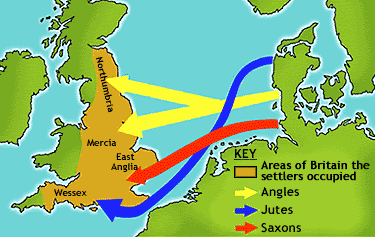
Germans in Early TimesWhen the invaders (Angles and Saxons) from coastal Germany overran Romano-Celtic Britannia around 1500 years ago and made it into England, they brought with them a very decentralized, largely tribal system of government that was very different from the Oriental despotisms that had ruled the civilized world for most of human history up to that time. And they liked their decentralized system very much. So much so that the system just kept on keeping on in England, century after century, despite many vicissitudes. Only the 20th century really shook it.
This account of English origins is not at all original. Montesquieu, De Tocqueville and Jefferson all saw English exceptionalism and independence of spirit as tracing back to German roots and all relied particularly on Tacitus for their view of the early German character. The work of Macfarlane (1978 & 2000) is however probably the best modern reference on the topic.
But let us look at what
Tacitus said. Excerpts:
They choose their kings by birth, their generals for merit. These kings have not unlimited or arbitrary power, and the generals do more by example than by authority.
About minor matters the chiefs deliberate, about the more important the whole tribe. Yet even when the final decision rests with the people, the affair is always thoroughly discussed by the chiefs. They assemble, except in the case of a sudden emergency, on certain fixed days, either at new or at full moon; for this they consider the most auspicious season for the transaction of business. Instead of reckoning by days as we do, they reckon by nights, and in this manner fix both their ordinary and their legal appointments. Night they regard as bringing on day. Their freedom has this disadvantage, that they do not meet simultaneously or as they are bidden, but two or three days are wasted in the delays of assembling. When the multitude think proper, they sit down armed. Silence is proclaimed by the priests, who have on these occasions the right of keeping order. Then the king or the chief, according to age, birth, distinction in war, or eloquence, is heard, more because he has influence to persuade than because he has power to command. If his sentiments displease them, they reject them with murmurs; if they are satisfied, they brandish their spears.
In truth neither from the Samnites, nor from the Carthaginians, nor from both Spains, nor from all the nations of Gaul, have we received more frequent checks and alarms; nor even from the Parthians: for, more vigorous and invincible is the liberty of the Germans than the monarchy of the Arsacides.
Our modern-day parliamentary procedures are a little more sophisticated but the basic values and principles seem to me not to have changed at all. As Razib at
Gene Expression points out, in the 2002 Index of Freedom, all the top countries seem to have a connection to the Anglosphere or are Germanic. Indian institutions and political customs have of course been enormously influenced by Britain.
It could also be said that the decentralized nature of the early German communities was no different from the decentralization in Greece before the Athenian Empire, the decentralization in Italy before the ascendancy of the Roman Republic or indeed the decentralization of the original Mesopotamian civilization. The important point, here, however is the much longer survival of that form of organization among Germans -- and it is certainly to Germans that the English must trace it.
A picture is said to be better than 1,000 words so
this link to a BBC educational site should help fix in our minds the fact that the English are historically the Western branch of the Germanic people -- and that the basics of what is German should also therefore be the basics of what is English. Though 1500 years of history can create a lot of differences, of course. The words in the yellow text-box are particularly relevant to my stress on the historical importance of political decentralization among the Germanic peoples.
There is now even some evidence that the German influence on Britain may have had a much earlier wave as well. When the grave of the so-called
"King of Stonehenge" (dating from about 2300 BC) was opened, he was found to be of Southern German origin:
"Different ratios of oxygen isotopes form on teeth in different parts of the world and the ratio found on these teeth prove they were from somebody from the Alps region," said Tony Trueman from Wessex Archeology.
Germans in more recent timesTracing the English love of liberty to the ultimately German descent of most of the English population will to many seem colossally perverse in view of Germany's recent experience. Was not Hitler a German and was he not almost the ultimate despot and centralizer of power in his own hands? One could quibble here by saying that Hitler was NOT a German (he was an Austrian) and the Israeli historian
Unger (1965) has pointed out that Hitler was much less of a despot than Stalin was but neither of those points is really saying much in the present context.
A very easy way out of this dilemma might be to say that 1500 years of history can make a lot of difference in the evolution of a people. The English could well have retained their traditions of 1500 years ago while the incessant brutalizing wars of Europe could have caused modern-day Germans to have lost their traditions of 1500 years ago. And that could indeed be part of the answer.
Another answer that seems superficially plausible is to argue that the undisputed tendency for the German invaders of Britannia to intermarry with the native Celts produced a hybid population in England that is no longer really German.
Recent genetic evidence (See also
here and
here) does confirm early accounts of intermarriage by showing that modern-day England (as well as Scotland, Wales and Ireland) is still substantially Celtic. So therefore the modern English are not as German as the Germans of Germany. To argue that, however, is to ignore the fact that Germany too has undergone great populations shifts and movements. The Saxons, for instance, were a coastal tribe 1500 years ago but certainly are not that today. So Germans too have undoubtedly intermarried with the more Southerly people into whose lands they moved. And who were the people to their immediate South? Celts! So the population of modern-day Germany too undoubtedly has a strong Celtic admixture -- particularly in the South. Southern and Northern Germans today do tend to see themselves as quite different from one-another. So both modern England and modern Germany are in no sense racially "pure". In both cases we are looking at a diluted ancestral infuence. Different ancestry is not therefore as obvious an explanation for modern day English/German differences as it might initially seem.
The explanation for modern-day English/German differences that I incline towards is that England's freedom from invasions over the last 1,000 years has allowed the English to develop their original Germanic traditions and practices with fewer constraints than those suffered by Germans on the Continent. I would argue that English traditions, practices and values are a more highly evolved version of the same traditions, practices and values that Continental Germans have.
But that, of course only invites more questions: What is the source of those traditions, practices and values? Can traditions and practices survive enormous vicissitudes for over 2,000 years? And if so, why and how? In answering such questions, I think we have to take into account recent findings in behaviour genetics. I think such findings suggest that the common core that both Germans and the English have built upon in developing their traditions, systems, practices and attitudes is in fact their common genetic heritage
There is now ample evidence from twin studies showing that identical twins reared apart are almost as similar to one-another as are identical twins reared together. In other words, genetics accounts for far more of what we are than environment does. And this high degree of genetic influence does extend to ideology. Conservatism is highly heritable (Martin & Jardine, 1986 and Eaves, Heath, Martin, Meyer & Corey, 1999). It seems in fact to be slightly more heritable than stature (i.e. how tall you are). So attitudes and values DO quite strongly tend to be genetically inherited. This clearly does raise the possibility that the original Germanic independence of spirit and respect for individual liberty may have been more than a matter of mere tradition. It may have been genetically encoded.
If that is so, we would expect that the Germans of today, despite the various things that have befallen them in the last 1500 years, might still show at least some residue of that original independence of spirit. I believe that they do. Nobody would argue that respect for the individual is as strong in Germany as it is in England but I believe that some German distinctiveness of the same general kind has persevered right down to modern times. So we need to look at the Hitler episode a bit more carefully at this point and ask whether it might not be exceptional rather than typical in German history -- for all the wartime propaganda to the contrary that one still occasionally hears.
Before we go on to the historical data, however, some psychological data might help plant a few seeds of doubt about the conventional view of Germans: Koomen (1973) showed that prewar Germany did not have characteristically authoritarian child-rearing practices. He concludes:
"Secondary analysis of data concerning periods before and after the war showed that before the war, only differences in parental control with regard to daughters could be demonstrated; parental control concerning sons appeared to be approximately the same in the two countries" [Germany and the U.S.A. (p. 634)].
And one of my survey research reports is perhaps even more surprising. In
Ray & Kiefl (1974) I reported that Germans in the 1980s in fact had distinctly "Hippy" values. Could Germans have changed almost overnight from robot-like automations to the exact opposite? It does seem improbable and history helps reinforce the view that Germans have not in fact changed much.
"Kaiser Bill"The first modern historical fact we need to note is that at the outbreak of the
First World War in 1914 Germany was a democracy: And a rather enlightened one at that which took better care of its people than almost any other country at that time did. Wartime propaganda which portrayed the war as the doing of "Kaiser Bill" still lives on but the legal powers of the German monarch were in fact not dissimilar to those of the British monarch. This entry about the Kaiser from the
Encyclopedia Britannica is a useful starting point for understanding what actually went on:
William often bombastically claimed to be the man who took the decisions. It is true that the German constitution of 1871 put two important powers in his hands. First, he was responsible for appointing and dismissing the chancellor, the head of the civil government. Admittedly, the chancellor could only govern if he could get a majority in the Reichstag, but this limitation on the emperor's freedom of choice was more apparent than real, because most members of the Reichstag felt it their loyal duty to support whomever the Kaiser appointed. Secondly, the German Army and Navy were not responsible to the civil government, so that the Kaiser was the only person in Germany who was in a position to see that the policy followed by the soldiers and sailors was in line with that pursued by the civil servants and diplomats. Thus, British journalists and publicists had some justification when during and immediately after the war they portrayed the Kaiser as Supreme War Lord, and therefore the man who, more than anyone else, decided to make war.
As time passes, however, historians are increasingly coming to see William as an accomplice rather than an instigator. In the years after 1890 the German upper and middle classes would have wanted a larger say in the world's councils no matter who had been on the throne, and this "urge to world power" was almost bound to bring them into collision with some of the existing great powers. The chief real criticism to be made of the Kaiser is that, instead of seeing this danger and using his influence to restrain German appetites, he shared those appetites and indeed increased them, particularly by his determination to give Germany a navy of which it could be proud. He was a quick-witted, well-meaning man who went with the stream instead of having the vision and strength of judgment to stand out against it.
So the difference between the British and German monarchies was not so much one of different legal powers but of different styles. The Queen is also legally the one who appoints British Prime Ministers and who is head of Britain's armed forces. Just because the British monarch normally does not exercise visible power may create the illusion that he/she has no power but the power is in fact there. This is best shown in Australia, where the royal powers are vested in the Governors and Governors General. These viceroys have in fact twice in the last century exercised their vice-regal powers to dismiss elected governments!
I might add that the Britannica's comment that the German parliament felt duty-bound to support whatever Chancellor (Prime Minister) the Kaiser chose is a gross exaggeration. Even the brilliant Chancellor Bismarck had a lot of trouble with German parliaments. Germany was undoubtedly in 1914 as much a democracy as the Britain it went to war with. And that democracy continued after the war -- so that Hitler himself came to power by essentially democratic means (See
here for an extended discussion of that). So a democracy that was interrupted only by the 12 year rule of Hitler is a pretty persistent democracy. Even England had a dictator (Cromwell) for a short period in its history.
PrussiaThose who know their German history, however, will often reply that it is not so much Hitler as his Prussian predecessors who show Germans as not being democratically inclined. The Prussians were the people who created the modern German nation in the first place. Roughly speaking, Prussia is the Northeastern part of Germany which, over the course of the 19th century, gradually came to dominate the whole of Germany. And the Prussian army had a famous tradition of requiring that its troops be
Kadaver gehorsam (corpselike obedient) so how that squares with my claim of a Germanic respect for individual liberty does at first seem very difficult to explain indeed.
Perhaps the first thing to note about the Prussians, however, is that they were not originally Germans. They were a Baltic people until conquered by the Teutonic Knights and the Old Prussian (Baltic) language did not die out until the 17th century.
The second thing to note is that the militarized and bueaucratized nature of the Prussian State was largely the the creation of one man -- King Frederick William I, who ruled from 1720 onwards. And although Frederick William was undoubtedly German, he may have been assisted in setting up his militarized State by the large non-German element in his subjects.
Frederick William's son, Frederick the Great (who reigned from 1740), did nothing to undo the efficient bureaucracy set up by his father and made triumphant use of the army created by his father but he was nonetheless notably tolerant and humane. He was hailed by Voltaire (whose model was England) as the
"philosopher king" and was noted for instituting freedom of conscience in religious and other matters. As a result, at one time the only place in Western Europe where the Jesuit order was legally permitted was Protestant Prussia. And Voltaire was welcomed in Prussia at times when he was unwelcome in France. So, under Frederick, Prussia was the acme of individual liberty in the continental Europe of the time! An efficient military did NOT mean an oppressed citizenry. Even in militaristic Prussia, the ancient Germanic respect for individual liberty was alive and well and thriving.
So Frederick's Prussia showed that militarism and individualism can coexist. Making it happen is perhaps a difficult trick and perhaps it is a trick that only Germanic peoples can manage but Frederick showed that even extremes of both (for the times) can coexist. It may also be noted that our Anglo-Saxon ancestors were great warriors too but they also still respected individual liberties.
The third thing to note is that rigid obedience to orders was NOT a requirement higher up the chain of command in the Prussian army. The famous Prussian general and military theorist, Clausewitz (1976), is clear that an innovative, flexible, opportunistic, improvisatory strategy is of utmost importance among military commanders.
Kadaver gehorsam was, in other words, even in the military context a strictly limited requirement. Germans have always been good military men and the strict obedience to orders of the ordinary soldier is an age-old military ideal. It has no necessary implications for what is true of the society as a whole. The armies of many very different societies have endeavoured to impose such an attitude in their troops -- though probably it is only the Japanese who have ever achieved it.

Perhaps a final potshot at misconceptions about Prussia and Prussian militarism can be found in the reality of the life of a great Prussian general, Helmuth von Moltke, above. A ruthless military robot? Not quite. He was the brilliant strategist and long-time head of the Prussian army who crushed the French at Sedan in 1870. The following is from Wikipedia:
Moltke loved music, poetry, art, archaeology, and theater. He knew seven languages (German, Danish, English, French, Italian, Spanish, and Turkish). He was a prolific artist who filled sketchbooks with landscapes and portraits, as well as a popular author... his account of travels in Turkey, released after his return to Berlin in 1840 and illustrated with his own drawings, turned him into a literary celebrity, a role that he embraced by donning a Turkish and giving public lectures... For all his catholicity of interests, Moltke was no closet liberal. He was a nationalist to the core who was appalled by the liberal revolutions that swept Europe in 1848. He placed his faith in the king and the forces of the old regime.
And a robotic attitude was certainly not true of Prussians generally. Prior to their partial subjugation by another strong figure in German history -- Bismarck -- the Prussian parliament (Yes. They
DID have a parliament) was in fact notably liberal (in the 19th century meaning of that term). Though Napoleon himself ran a police State in France, Prussian legislators of the 19th century were influenced by his liberal ideals rather than his authoritarian deeds. As one small sign of that, the emancipation of the Jews was proclaimed in Prussia in 1812. So to mistake Prussian military requirements for the nature of Prussians themselves is a large mistake.
In fact even the great Bismarck himself led a dissolute, disorganized and irresponsible life in his youth that went pretty close to what we now would call "hippy". He did not in fact settle down and begin his rise to power as the "Iron Chancellor" until he married -- at age 32. And he was far from alone in having an early life of a very free-wheeling kind. It could in fact be argued that the old German
Wanderbursche tradition and the later
Wandervogel movement were long-standing adaptations to and acceptance of hippy values in German youth. So the hippy values of Germans today are not remotely the departure from the past that they might at first seem to those who do not know German history.
Myths about the Third ReichAnd, perhaps surprisingly, Prussia was, for all that, closer to being an autocracy with centralized power than was
das dritte Reich. The idea that Hitler's Germany was a nation of bureaucratized automatons under a single iron rule exists only in the popular imagination. Any comprehensive history of
das dritte Reich (e.g. Shirer, 1964; Bullock, 1964) will tell you that power was if anything excessively decentralized and unfocused under Hitler. Hitler's immense popularity and respect in the country gave him ultimate authority but he exercised it only in a desultory and general way -- leaving most decisions and all administration to his subordinates. And he deliberately gave his subordinates overlapping jurisdictions so that they continually had to compete with one-another for power. Power in Nazi Germany was polycentric, not centralized.
And nor were his subordinates rigid automations. Contrary to the Hollywood stereotype, the Nazi armies were far from being filled with rigid bunglers. Their remarkable initial successes against overwhelming odds (Dupuy, 1986) should alone suggest that but see also Hughes (1986). Both on the home front
(Singer & Wooton, 1976) and in the field Hitler's Germany can be shown to be flexible and improvisational rather than rigid and formal.
Hitler's closest friend and the person he spent most time with was Albert Speer (his architect and armaments minister) yet when allied bombers destroyed a building containing most of the records of his armaments ministry, Speer rejoiced at the loss. He welcomed the opportunity to make a new start. He was innovative rather than rigid (Singer & Wooton, 1976). He was an exponent of "some of the most advanced, participative and 'humanistic' management theories being endorsed today"
(Singer & Wooton, 1976, p. 79). He called his theory of management "organized improvisation" and he believed in collegial forms of decision-making. He also practised a "loose or fluid manner of structuring organizations" (p. 83). Note that word "collegial" -- meaning that everyone had a say and decisions were collective rather than imposed.
So there was Speer right at the heart of power in Hitler's Reich and yet he exercised his power consultatively and with considerable deference to others rather than autocratically. He behaved, in other words, pretty much as Anglo-Saxon kings did 1500 years before him.
And Speer's lack of rigidity and formality was also true of Hitler's generals. It was only their flexibility and creative thinking that enabled them to achieve so much against numerically much superior odds. The example of Rommel is of course well known but a better example is in fact von Manstein -- architect of the
Blitzkrieg through France. At the outset of the French campaign, von Manstein faced heavily entrenched French and allied forces that were in no way inferior to the German forces but his bold and innovative
Panzer-led strike through the Ardennes outflanked the French forces and routed them completely. And later in Russia, von Manstein destroyed two Russian armies even AFTER Stalingrad. And his conquest of the Crimean peninsula is legendary among military historians: a frontal assault against superior forces who had nearly every advantage: a fortified position, command of the sea, the air, and tanks, while his army had not one tank. So even Hitler's Germany was very much a nation that allowed much scope for creative individualism -- as long as you did not threaten the overall power structure, of course.
The creativity of Nazi Germany can also of course be seen in the large number of innovative weapons systems that it deployed -- cruise missiles, ballistic missiles, radar and jet aircraft. The Focke company also produced the first workable helicopter -- though it was not used militarily. Perhaps most remarkable of all, Nazi Germany successfully deployed
precision guided bombs nearly 50 years before US forces first used them to any extent (in the first Iraq war) and the Nazi engineers did it all without benefit of computer technology. And one of the guided weapons concerned -- the amazing
Mistel -- had a warhead that would detonate on impact in an
explosion that could penetrate 8 meters of steel or 20 meters of ferroconcrete -- which is significant ordnance even by
modern standards.
So Hitler's Germany was in fact much more individualistic, original, flexible and decentralized than is generally realized.
Unger (1965) has pointed out that Hitler's regime was much less totalitarian than Stalin's. We can now suggest one reason why: Because it was German.
This comparison by Hoppe of the Hitler and Stalin regimes may also be worth noting:
"From 1929 to 1939, in peace time, Stalin and the Bolsheviks killed about 20 million Soviet citizens, for no predictable reason. Hitler and the National Socialists ruined the businesses and careers of hundreds of thousands of German citizens, but the number of people killed by them before the outbreak of the war was only a few hundred, most of them fellow Nazis and all of them for a predictable reason. Even immediately after the onset of the war, when it became known that the Nazis had begun to engage in mercy killings of the incurably insane (euthanasia), the Catholic bishops, led by Bernhard von Galen, openly protested, and German public opinion compelled the Nazis to halt the program. Bishop (later: Cardinal) von Galen survived the Nazi regime. Under Stalin and the Bolsheviks, any such opposition was impossible and Bishop von Galen would have been quickly disposed of."
But perhaps the most important thing to note about the Hitler regime is how shortlived it was -- 12 years. That of course makes it a very poor criterion of what is typically German. All countries have tyrannical episodes. The ferocious despotism of Henry VIII or the oppressive Puritanical rule of Oliver Cromwell in England may be noted as well-known instances of that.
But even if we overlook its very shortlived nature, we see that the Hitler regime does little to challenge the notion of Germans as individualists rather than conformists and we have already seen that militaristic Prussia is a poor challenge to that notion too.
Germany before the Prussian ascendancyPerhaps the most important thing here, however, is to see things with an historian's eye and realize that recent times in general have been atypical for Germany. Right up until Prussia's ascendancy in the late 19th century, Germany was remarkable for its degree of decentralization. What we now know as Germany was once always comprised of hundreds of independent States (kingdoms, principalities, Hanseatic cities etc.) of all shapes and sizes: States that were in fact so much in competition with one another in various ways that they were not infrequently at war with one-another.
Like many other groups, however, Germans encompass a wide variety of subgroups within their ranks and Prussians are one such subgroup. Prussia, however is only one part of Germany and in fact for most of its history it was only partly German -- including large numbers of Poles, Silesians and other non-Germans. Furthermore, the Prussian ascendancy was also both very recent and very short-lived. It dates essentially from the French surrender at Sedan in 1870 and ended with the flight of the Kaiser to Holland in 1918 -- to be succeeeded by the very un-Prussian Weimar Republic. Those 48 years are undoubtedly of enormous significance to the world but all that they show essentially is that Prussian militarism had some initial success but ended up destroying itself.
Prior to Sedan, Germany was a disunited and decentralized agglomeration that generations of Prussians, French and others tried unsuccessfully to subdue. And after Sedan, unity of a sort was achieved and maintained only by the diplomatic genius of Bismarck. And even with the armed might of Prussia behind him even Bismarck had a lot of trouble with the other German States. He could not even get his Prussian monarch declared as being "Emperor of Germany". He had to make do with "German Emperor" as a title. And even Bismarck was not able to shake the independence of the Germans in the Austrian lands. He had to be content with them as not always reliable allies.
And after the remarkable restraint provided by Bismarck was dispensed with by the new Kaiser (Wilhem II or "Kaiser Bill"), the German Empire very quickly self-destructed. We know it as World War I. And Hitler's attempt to revive it went the same way.
So now Germany is back to something much more like what it always was -- a nation with a strongly decentralized power structure in the form of the various
Land (State) governments. And that is of course exactly the same structure that certain other countries of mainly Germanic origin (the USA, Canada and Australia) have adopted too -- a system of State governments which markedly limits central (Federal) government power. And it might be noted that "devolution" is rapidly leading to a similar state of affairs in Britain itself. So the German origins of the English do make their historic dislike of concentrated power at the Centre just one part of a larger picture.
To summarize the main points of what has been said so far about recent German history:
1). Germany has historically been notable for its decentralization of power and is still relatively decentralized today.
2). The Prussian hegemony of Germany and the Nazi domination of Germany were both relatively short-lived (48 and 12 years respectively) by comparison with a history of Germany that stretches back for over 2000 years so cannot by themselves be the basis for much in the way of generalizations about Germans. We might as well argue from the despotism of Henry VIII (38 years) or the Cromwellian Protectorate (6 years) that Englishmen do not value their liberties.
3). Although both Prussia and Nazi Germany undoubtedly had strong autocratic features, that is far from the whole story. Both kings and parliaments of Prussia were in fact for much of the time remarkably liberal (in the original 19th century sense of that term) by the standards of their day and Nazi Germany also was remarkably polycentric in its power structure. So even these "worst case" regimes still retained much of the ancient German diffused power structure that the Anglo-Saxons brought with them to what became England.
For another treatment of the Germanic role in the evolution of Anglo-Saxon liberty see a wide-ranging article by
Razib. He agrees with my contention here that Germanic origin maps respect for the individual a lot better than the prevalence of Christianity does.
And it was of course only the fractionated and competing centres of power existing in mediaeval Germany that enabled the successful emergence there of the most transforming and anti-authority event of the last 1000 years: The Protestant Reformation. Despite the almost immediate and certainly widespread popularity of his new teachings among Germans, Luther ran great risks and would almost certainly have been burnt at the stake like Savonarola, Hus and his other predecessors in religious rebellion had it not been for his (and our) good fortune that he was a Saxon. His Prince, Frederick III ("The Wise") of Saxony gave him constant protection. As one of the Electors of the Holy Roman Empire, Frederick was strong enough and independent enough to protect Luther from Pope, from Emperor and from other German potentates.
And the example of Luther highlights why decentralization of power is important: It introduces diversity. In theory, there is no reason why a set of decentralized mini-states cannot all be despotic. So decentralization is not necessarily a good thing in and of itself. It is good because of what it leads to. And what it leads to is choice. And where there is choice people can vote with their feet. A ruler that is too despotic will simply lose "subscribers" (citizens). His population will tend to decamp and put themselves under a less tyrannical ruler next door. So the power of any one ruler is constrained by the knowledge that his more valuable citizens in particular have an "out" if he shows too little consideration of them. And this was true of course not only in Germany for most of its history but also in Renaissance Italy. Especially skilled individuals such as Bach, Haendel or Leonardo did change rulers from time to time in a search of a better deal for themselves.
As it happens, however, both in Tacitus and in accounts of the politics of the early Anglo-Saxon kingdoms of England, we do see a picture of power that is not only decentralized but also power that is exercised consultatively. And that connection is of course far from automatic. As we see in the case of Prussia and in the case of some of the Italian city-states, this is not always or necessarily so. Decentralized power can still be power that is exercised in a highly undemocratic way. But decentralized power IS fractionated power and the tendency for fractionation to exist not only between states but also within states is obviously strong. This is shown not only in the Anglo-Saxon case but also in the case of the Italian city-States of the renaissance -- many of which (such as Venice) were republics. Italy, however, is perhaps a case where independence of mind is excessive. Italian government to this day is chaotic. The Germanic people are the ones who seem to have struck a balance between individualism and the ability to accept discipline when required.
Some extracts from a
review of
The Gifts of Athena: Historical Origins of the Knowledge Economy (2002) by Northwestern University economist Joel Mokyr reflect a similar view of how the technological and social evolution that created the modern world depended critically on individualistic groups who were able to express their individuality because of the decentralization of North-Western Europe.
"The rate of technological development has been deeply affected by the fact that people who studied nature and those who were active in economic production have been, through most of history, by and large disjoint social groups." ....
Eighteenth century Europe also fractured into many independent sovereignties at the conclusion of the religious wars that had wracked continent for the previous two centuries. This political diversity promoted greater freedom of thought among merchants, scientists, and other thinkers, who would often simply pick and up leave if the government of one place displeased them. ....
Those who still doubt that there is any connection at all between decentralization of power and individual liberty might reflect on the Magna Carta. It is rightly regarded as the founding document of English liberty and democracy and yet it was signed only because the decentralized power of the barons forced it to be signed.
"Germanic", "Teutonic" and the JewsMost readers should by now be feeling a bit dubious about my line of argument. Is what I am saying not reminscent of Nazi doctrines of German racial superiority? Am I not attributing at least one type of superiority to Germans just by reason of their being German?
In response I have to say that I have been a student of the Nazi phenomenon for most of my adult life and have even written several papers for Jewish journals about it but I still do not know what Hitler thought to be historically Germanic -- other than that it was martial and pagan. On my reading he had no clear idea of it at all: Just confused and contradictory utterances from time to time. As "Robert Locke" pointed out in the August 28, 2001 issue of "Front Page" magazine, Hitler was in fact much
more vocal about being Aryan than being
Germanisch. So it is difficult to show that my ideas are dissimilar to Hitler's without knowing exactly what his ideas were. His speeches are raves rather than anything logically consistent (though they did, of course, have great emotional consistency).
I guess, however, that the one lesson he would NOT draw from German history is precisely the one that I DO draw: That the German spirit is inimical to tyranny and in favour of individual liberty. I think it is fairly clear at least that individual liberty was not one of his priorities. The Nazi
Fuehrerprinzip (leadership principle) was in fact diametically opposed to individualism of any sort. So does not my view of what is Germanic make me precisely ANTI-Nazi? I think it does.
But why should I even try to make such distinctions between my arguments and Hitler's? I do not really see why a rational debate should be distracted by irrelevant comparisons with a populist demogogue. On the other hand, I do not like to give needless offence so I am making this clarification.
Actually, I should probably have been using the word
"Teutonic" instead of "Germanic" as it is clear that everything I have so far said about the Anglo-Saxons is equally true (if not more so) of the Scandinavians. Those Vikings were certainly an individualistic, independent and decentralized lot! They also treated women more or less as equals and have a great history of democracy. The oldest continuously sitting parliament in the world is in fact the
Althing of Iceland -- with a history going back 1,000 years. And Scandinavians are almost 100% Protestant too -- which fits with a spirit of independence and individualism.
As to Jewry, I no more believe in Jewish conspiracy theories than I believe in the man in the moon. I will leave such beliefs to the simple-minded of both political extremes. I am and always have been, however, an unapologetic and unreserved supporter of Israel. But I hope nonetheless that I have the sort of balanced view of the Jews that one should have of any group -- seeing both strengths and weaknesses. I think that Jews in general are a remarkable and admirable people but I do not think that they are right about everything and I think that their historic collectivist doctrine that they are a "chosen people" has been both a blessing and a curse to them.
And insofar as Christians have adopted such "groupthink" it has been a dubious influence among them too. Fortunately, St. Paul (a Jew) initially set Christianity on a much more inclusive path (Romans 2: 25-29; 1 Corinthians 7: 18,19; Galatians 3: 26-29; Colossians 3:11) than that adopted by Jews before him so group consciousness has not had such good precedents among Christians. The way both Catholics and Protestants have engaged in persecution of those not of their faith does however show that religious groupthink is far from absent among Christians.
Interestingly, both modern Jews and ancient Jews have always been fractious and disunited so Jews could be an inspiration to those who OPPOSE collectivist thinking if we looked at what they did rather than what their religion preaches!
Protestantism versus CatholicismLuther has been mentioned as a beneficiary of Germanic power decentralization but Luther's message received wide acclaim in Germany generally so it seems reasonable to say that German distrust of centralized power not only
protected Protestantism but was was in fact
a major cause of Protestantism. Because what is Protestantism after all if it is not a rejection of centralized religious authority? So in that sense, conservatism and Protestantism are twin children of Germanic suspicion of centralized power.
Looking at it another way, we could say that Protestantism is the Germanic form of Christianity and that conservatism is a political expression of religious Protestantism. There always have been, however, many forms of Protestantism and some forms (e.g. the Puritanism of England during the time of Cromwell's Protectorate) were very restrictive of individual liberty.
Further, where the Roman Catholic believes that the sacraments administered by a religious authority (a priest) are essential for his ascent into heaven, the Protestant believes that he can commune with the Almighty directly. Catholicism fosters habits of submission to authority whereas Protestantism inculcates hardy independence. So acceptance of government authority over oneself should come as naturally to the Catholic as it is alien to the Protestant.
So German history could at a pinch be seen as a struggle between native decentralizing tendencies and Catholic centralizing tendencies --- with the (more Celtic) German lands closest to Rome remaining Catholic and Imperial while the (Northern) German lands farthest from Rome remained independent, Protestant and decentralized. And the struggle the North had to resist the Imperial South was indeed a titanic one --including the famous 30 years war from 1618 to 1648.
As some evidence that there is still something left of that difference, it might be noted that, in interwar Germany, the Protestant North was largely "Red" (revolutionary) whereas the Catholic South was largely Nazi -- i.e. more prepared to operate within the existing power structures and more prepared to accept the Church. Hitler did after all have a Catholic education.
So how do we account for the fact that "Christian Democratic" (i.e. Catholic) political parties seem generally to be the major conservative forces within modern European politics? And how indeed do we account for the fact that at least 50% of Germans are to this day Catholic?
A essential part of the answer is of course the counter-reformation -- a process that began in response to Luther and which restored the acceptabity of Catholicism to many Germans. This reform process within the Catholic church may have begun in response to Luther (though Luther had precursors) but has in fact been an ongoing process within the Catholic Church ever since --- with the relatively recent Vatican II ecumenical council being a particular highpoint of the process. So the Catholic church could only combat the power of Luther's message by partially bending to it and thus becoming itself to a large degree Protestantized and weakened in authority. And the way a huge proportion of otherwise convinced Catholics now disregard the teachings of their church on such matters as contraception shows vividly that the authority of the Church is now in fact mostly an empty shell.
So in various guises Germanic Protestantism has won the day over Roman authority in the religious sphere just as Germanic conservatism has won the day over socialism in the political sphere. We now have Protestantized Catholics and
"Thatcherized" socialists in much of the world.
Nonetheless, even in a weakened form, the Catholic church offers a model of "top down" social organization that must make it easier for Catholics to accept political arrangements of a "top down" sort. If you look up to the Pope as an essential part of your salvation in the spiritual sphere, to look up to the government as an essential agency in securing your material wellbeing is surely only a small step. So the fact that the vast majority of Europeans are still Catholic (even if the Catholicism is much watered down from what it was) should make Europeans more accepting of all-pervasive government than Anglo-Saxons would ever be. And so, of course, it has come to pass. In Bismarck, Hitler, Mussolini, Franco, Salazar, Horthy, Pilsudski, Antonescu and Papadopoulos, Europe has had authoritarianism in government on a scale unknown in the English-speaking world. And we don't need to mention Stalin and the Russian Orthodox "Third Rome".
So how conservatism has evolved in the modern-day English-speaking world is rather different from how conservatism has evolved in Europe. Anglo-Saxon conservatism benefited greatly from Henry VIII, who made England almost totally Protestant. Protestants in Germany failed to achieve this dominance and so England has been better able to stay close to its Germanic and Protestant roots -- whereas European conservatism has never totally escaped Catholicism. European conservatism has therefore mostly lost its anti-centralization principles and conforms much more closely to the stereotyped image of conservatism as being merely a defence of traditional arrangements generally. This of course makes it a much weaker form of conservatism and the huge bureaucratization that now characterizes the European Union is vivid evidence of that. European conservatives have been much less effective as opponents of big government because opposition to big government is much less of a central position for them.
Scotland, liberty and the creation of the modern worldMy sole focus in discussing the Germanic tradition so far has been on individual liberty. There are however other ways in which Germanic and Protestant civilization is often alleged to have played a leading role in shaping the modern world. In particular, the German reformation is seen as enabling a freedom of thought that eventually brought about the English industrial revolution and hence modern civilization as we know it. And as part of that process the scientific technical and engineering innovations that enabled the modern world do almost all seem to have flowed from Germanic countries -- principally Germany itself and Britain. From the printing press to the steam engine the creation of technological civilization seems to have flowed almost entirely from the Germanic peoples of Northwestern Europe.
I think that there is a large element of truth in this account but do not place any great reliance on it. It seems to me that the account overlooks very substantial contributions from France and Italy for a start (e.g. Marconi, Pasteur etc.) -- though it could also be argued that both the Northern French and the Northern Italians have substantial German elements (e.g. the Franks and the Lombards) in their ancestry.
Another objection is the role of the Scots. In his book
How the Scots Invented the Modern World, Arthur Herman points to the very substantial contribution made by Scots to the the development of modern Western thinking and the invention by Scots of much in modern Western technology. So how does that square with the contention that the modern world was essentially a Germanic invention? Surely the Scots are Celts rather than Germanic!
I doubt however that the Scottish case constitutes a crucial objection. Some reasons why:
* To my knowledge both the Chinese and the Russians make similar claims to have produced many great inventions. Most things seem to have had more than one "inventor"
* There is an awful lot that the Scots did NOT invent -- from the printing press onwards.
* The Scottish lowlands (where most Scots live) were thoroughly colonized by the Anglo-Saxons so most Scots have substantial Germanic ancestry.
* The Celtic Scots got at least Germanic culture via Protestantism and the English hegemony generally.
The reviews in the Amazon site linked above are well worth a read.
On the political front however, the Scots show very clearly the Germanic difference. Scotland has long been heavily socialist, returning very few Tory members to the Westminster parliament. When English voters swung very heavily towards Margaret Thatcher in 1979, Scotland actually swung away from the Tories! So the greater Celtic element in the Scots ancestry does seem to make a marked difference in politics. Where the Germanic English favour individualism and conservatism, the Celtic Scots favour collectivism and socialism.
I have more on the Scots
here and
hereFull citation details for all references given above can be found here.FINIS