I have written two large books about Leftism/Rightism (online here and here) but the number of people who have read both right through is probably no more than one -- myself. So for the casual reader, the following brief essay may have to suffice
A short essay on Leftism
By John Ray (M.A.; Ph.D.)
By "Leftist" I mean here someone more extreme than a mere VOTER for a democratic socialist party such as The Australian Labor Party or the U.S. Democratic party -- though Leftists in my sense may well be members and officers of such parties. I mean by "Leftist" someone who is committed to a high degree of control over society and coercion of people in it with the ostensible aim of "levelling" incomes and other privileges among people in the society concerned. In the 20th Century, such people normally had at least some Marxist sympathies.
What I think the facts show is that Leftists are basically angry, hate-filled people who hunger for power over others and enjoy hurting others but who hide their malign and hurtful motivations under a cloak of humanitarian intentions. Their anger at the ordinary people about them leads them to want to control, hurt and change those about them -- by violence and mass-murder if necessary. Their proclaimed humanitarian intentions and concern for "the worker" are, therefore, just deception and camouflage -- perhaps unconscious deception and camouflage in some cases.
There was a poster around the universities a few years back that is rather informative about the Left-wing viewpoint. It said: "I love humanity. It's just people that I can't stand". My own way of putting much the same point would be to say that Leftists (in my sense) say that they "care" for people but will cheerfully murder half of them -- whereas conservatives do not claim to love humanity but they do not want to murder half of them either.
I had a Communist girlfriend some years back -- a schoolteacher by trade, funnily enough. She had talents other than her politics. I noticed at the time how much anger she had in her towards all sorts of people and thought how well that fitted in with her support for Communism. She was basically a gentle nurturing person but anger leads to hatred and hatred leads to murder. It is hard for me to understand how any decent person can ever have supported anything as brutal as Communism but the fact that large numbers of intelligent people often did tends to show where anger and hatred can lead otherwise decent people.
The characteristic Left-wing slogan is: "Smash X" -- where X can be almost anything -- from the current government, to racism, to big business, to some particular law etc etc. They are very big on smashing things -- with revolution being only the most extreme example of that. If some person or group is not doing what the Leftist wants or thinks that they ought to do, the Leftist immediately wants to coerce them (with violence or otherwise) or murder them. Nice people! They want power over other people at any price. Beware anyone who stands in their way!
All the great mass-murders of the 20th Century (under the control of Hitler, Stalin, Pol Pot and Mao Tse Tung) were committed in the name of socialism and "the people". Compared to these crimes, lesser slaughters such as that by the Serbs in Kosovo (who were in any case led by their old Communist boss, Slobodan Milosevic) pale into insignificance. It is hard to think that anything could be worse than Serb troops throwing a 2 year old toddler down a well in front of his mother but "socialists" can do it.
My account of Leftist motivations would seem to explain a lot. It does make sense of a lot of seemingly senseless behaviour -- which is a good test of any scientific theory. For instance, only a fool or a scoundrel would advocate such counterproductive nostrums as State ownership of industry or rent control and I do not accuse those on the Left of being fools. They are too smart for their own good, if anything. They think no-one can teach them anything. Advocating State ownership of industry or rent control is nonsense if you really want to improve the long-term lot of the worker but is, of course, perfectly rational if your real main aim is to concentrate as much power and control as possible in your own hands (or in the hands of your clique).
In my view the reason why psychologists tend to be Leftist is also that psychology (like teaching) seems to offer the prospect of personal power over the minds of others -- the ultimate form of coercion. Leftists want that and are attracted to studying psychology for that reason. Fortunately their own innate dishonesty makes them very bad at it.
As I see it, most real Leftists (advocates of a high degree of State coercion and control -- who in turn are generally intellectuals of some kind) start out with some degree of intellectual orientation but little capacity for intellectual originality. They are, in other words, theologians rather than philosophers. They can debate and rehash an existing body of thought ad nauseam but are barren of new ideas. Anybody who knows the vast lengths to which they go to in debating "what Marx really meant" will see the appositeness of the "theologian" appellation. The excitement over the discovery of Marx's "Grundrisse" was also like the discovery of a new holy book. Nonetheless their intellectual orientation does alert them to the many ways in which the world around us is not ideal and makes them want to propose ways of improving things. Because they are not very good (i.e. unoriginal) intellectuals, however, they can come up with only the crudest of proposals (i.e. make people behave better).
When life eventually forces them to confront the evidence that their crude methods tend to be inhumane and counterproductive they face being shown up as the inferior intellectuals they are. They face being shown up as wrong and foolish, meaning that their self esteem is threatened. So they either abandon the Left-wing romance with coercion and change their views to more conservative ones or if they are really infatuated with coercion they stay Leftist by using any and every device available to aid that.
And the most insidious device that they can use is intellectual dishonesty. They simply refuse to believe anything adverse to them and will themselves lie to manipulate others ("for their own good"). Thus I remember Leftists of the bad old days in the '50s and 60's who greeted accounts of Stalin's purges and massacres of his own people as "inventions of the capitalist press". How do you persuade such people? You can say that we have a free press rather than a capitalist one but since mass media do tend to be big businesses this can be made to sound implausible too. The truth is that you cannot persuade such people and waste your time by trying. "There are none so blind as those who will not see". All the evidence on almost any question will seldom be available at any one time and place so all or almost all judgments of fact have to be made on a probabilistic basis. So all the intellectually dishonest person has to do is to keep demanding higher and higher probabilities before he will believe. You soon reach the point where that level is unobtainable so he looks like he has had a polemical victory of sorts. He has. Dishonesty has its rewards. It is still despicable and misleading, however. So a Leftist is also someone who uses dishonesty in support of coercion.
It may be argued that on my account of things Leftists should also tend to be policemen etc. Policemen have a lot of interpersonal power. In fact, of course, policemen, the military etc tend to be very Rightist. There are several obvious answers to this. Perhaps the most obvious is that these jobs are not very intellectual and the Leftist does start out as a (second-rate) intellectual. Another answer is that the ratio of gain to risk is high. Policemen and soldiers risk getting shot and only ever gain temporary power over a few individuals. For a power-mad Leftist that is just not a very attractive offer. It is a bad deal. When the Leftist takes up arms he tends to do so as a guerilla (so he can shoot from safety) and for very big stakes (major social change --a "revolution" -- that will make him a big-shot if it succeeds). He does not want power over just one or two individuals. He really wants power over everybody -- for himself or his clique. A really nice guy(!). Teaching or psychology, of course, offer power without much cost or threat.
There is some support for the account I have given in the academic literature. For example, a paper by Winter & Wiecking [Winter, D.G. & Wiecking, F.A. (1971) The new Puritans: Achievement and power motives of New Left intellectuals. Behavioral Science, 16, 523-530] tells a bit about Leftist power motives and the many books and articles by Rothman and Lichter [e.g. Rothman, S. & Lichter, R.S. (1982) Roots of radicalism: Jews, Christians and the New Left Oxford: Univ. Press] tell about Leftists being in love with themselves -- "narcissism" if you are being polite about it, "arrogance" if not. A paper by Himmelfarb gets it pretty right too [Himmelfarb, G. (1989) Victorian values/Jewish values. Commentary, 87(2), 23-31.]
As I said at the beginning, one must distinguish between real Leftists (a small but poisonous clique) and those who vote for them. Real Leftists (Communists, Trotskyists and their usually "intellectual" ilk) have virtually no voter support in moderately well-informed societies (i.e. in the developed world) but they do at times manage to dominate mass political organizations of democratic society (e.g. the British Labour party up until the late 90s). People who vote for such parties can often be (as S.M. Lipset points out in his 1960 book Political man) actually quite conservative. They tend to be working class people who simply vote for those who appear to offer them the best deal. In other words, Leftist lies and pretences of good intentions do sometimes gain votes from those least able to be critical. Even then, the Leftists cannot be too overt. The obvious extremism of the British Labour Party in the '70s and '80s was the main reason for the Conservatives' long term in office. Mrs Thatcher's biggest asset was the British Labour Party. People seldom liked her and her Conservative government much but liked the alternative even less. British Labour was in fact still so hopelessly in cloud-cuckoo land in the early 90s that they could not even beat the wimpish John Major in the midst of a recession!
I remember saying to supporters of the British Labour Party in the 90s, "But your lot are so hopeless that they couldn't even beat John Major". That remark was obviously far from original to me but it always went home. It tended to strike them dumb in fact. With the pain of having to bear remarks like that, no wonder they gave up most of their old policies soon after.
Under Tony Blair they in general became just another bumbling conservative party -- except for a bit of feel-good rhetoric and tokenistic reform (such as further reform of the already emasculated House of Lords and the banning of hunting to hounds). They even started to espouse "family values" -- the old catchcry of the religious Right. The penalty of their pre-Blair Leftist extremism was impotence. They gained power only by abandoning most of their old committments to Leftist causes. That the party of unilateral disarmament became the party of Iraq intervention was truly a seismic shift. Only their love of bureaucracy and big spending survived.
About a third of the people (e.g. in Allende's Chile) can sometimes be persuaded to support the Leftists. Some of those can be sincere. In the long run, however, they will learn. At what a price! Generally after many deaths: Tibet! China's Tienanmen Square and Great Leap Backward under Mao! The Hungary of Imre Nagy and Janos Kadar! The Czechoslovakia of Dubcek! The Cambodia of Pol Pot! The incredible human, economic and environmental disaster of Soviet Russia! What a lovely list of achievements for the so-smart Leftist intellectuals (really arrogant ignoramuses) to contemplate! Not that they care, of course.
FINIS
Monday, April 09, 2007

Friday, April 06, 2007
DETECTING RACISM IN THE BRAIN
John Ray (M.A.; Ph.D.)
I have not been able to get a look at the original research results behind this report (from November, 2003) that racism can be detected by measuring brain activity. The report is obviously sensationalized in that it refers to "white" racism only. Presumably black racism could be detected in a similar way. But I guess we are not supposed to mention black racism.
But assuming that the report is otherwise accurate, it fits in well with the point I often make that there is much evidence to show that racism of some sort is universal and natural. So if people are asked to suppress it -- which political correctness forces them to do -- some harm will result. And exactly that is what is reported: Suppressing banned thoughts is difficult and requires a lot of brain activity which could be better devoted to other tasks. And that people who have stronger convictions about the reality and importance of racial differences are the ones who find suppression of such views hardest is equally no surprise.
The thing that will disturb most people, however, is that something as private as one's thoughts can now be detected by a scientific machine. Suppressed thoughts about ANY subject would seem to be detectable by such a procedure. Orwell's "Big Brother" has arrived and the old anti-Nazi slogan Die Gedanken sind frei (Thoughts are free) is no longer true! Note however that a Leftist who is trying to suppress (say) his contemptuous thoughts about ordinary people could be similarly caught out. As soon as that realization dawns, I am sure the procedure will be BANNED!
I might point out in passing, however, that what the procedure does is not much different from what a traditional lie-detector test does. It just reports an upsurge in neural activity but detects it in a slightly different way. What are the actual thoughts behind that neural activity is, however, essentially a guess and there are ways of spooking the procedure.
BACKGROUND ON BRAIN SCAN RACISM
One of my "PC Watch" readers sent in this link that gives details of one of the people behind the recent "white racism in the brain" study. My reader comments: "I never would have guessed!"
FULLER REPORT OF THE BRAIN SCAN STUDY
I am pleased to find that New Scientist has a fuller report of the study about "white racism" being detected by brain scans.
Note this comment about how "racism" was measured: "The Implicit Association Test (IAT) is controversial. Gehring says "one must be cautious" regarding any claims that a test is a direct measure of racist attitudes."
And this comment on what the brain scan shows: "The team does not know exactly why this brain area should light up in people with biases. "They are either trying to inhibit or control something - but we don't know what that something is," she says. "It could be an emotional reaction, or thoughts that come to mind. Or it could be something as benign as simply trying not to make errors.""
In short, they had no good evidence at any point that they were measuring what they said they were measuring.
There are also some further dismissive comments at the end of the New Scientist article.
MORE ON THE VALIDITY OF THE IMPLICIT ASSOCIATION TEST
There are two articles here and here published in 2005 that summarize some further research by Indian psychologist Mazharin Banaji with the Implicit Associations Test (IAT) -- articles which again imply that the IAT is a "covert" measure of racism. The common finding reported from use of the test is that all sorts of people are quicker to pair "good" words with whites and "bad" words with blacks. The most surprising thing about the test is that many people who are conspicuously anti-racist show the same quickness to associate good with white.
Finding "covert" measures of anything -- and racism in particular -- has long been a "holy grail" for psychologists and there have been some conspicuous failures in the quest. So is the IAT the holy grail? Sadly, No. The first thing a psychometrician asks about any test of anything is: Is it valid? -- meaning, does it measure what it purports to measure? But there is another question logically prior to that: What does it purport to measure? And the answer in this case seems to be straightforward: It purports to ascertain whether a person has prejudiced, negative or antagonistic attitudes towards various minorities. That being so, the test is obviously NOT valid. It is not valid on what psychologists call a "criterion groups" examination. And it is precisely the feature of interest in the IAT that lots of people who are by any criterion either non-racist or actively anti-racist get high scores on racism according to the test. So the IAT does NOT pick out non-racist or anti-racist people accurately.
So does the test measure anything? Anybody who is familiar with the stereotyping literature will find that easily answered. There have now been many decades of research into stereotyping and the findings about it are roughly the opposite of what is popularly believed. There are two literature surveys here and here which document that. The important point for our present purposes is that stereotypes have long been found to have a "kernel of truth", as Allport put it. Far from being rigid or fixed, they are highly responsive to modification through fresh information. They are our first and most immediate response to any new situation -- but to be useful, they also have to be continually modified as information about the situation comes in -- and they are.
So what the IAT findings show is that the experience white people have of blacks is generally negative. Whites know from experience or observation that blacks in general are (for instance) more dangerous to them. Given the enormously disproportionate incidence of violent crime among blacks, it would be a sad day indeed if no-one had noticed that. So what the IAT measures is EXPECTATIONS of blacks, not ATTITUDES to blacks. It shows what we see as most probable about blacks but tells us nothing about any more complex attitudes we may have towards blacks. So the IAT simply records our experience of reality without telling us anything about how we interpret that reality.
That view of the IAT also explains why even many blacks associate badness with blacks. Blacks are of course the most frequent victims of black crime (for instance). Since it is very common for whites to shun blacks in various ways (no eye contact etc.) however, many blacks will still have most positive associations with their own kind. And the IAT shows that too.
There is an academic review article here (PDF) which also fairly effectively undermines the claims of the IAT as a measure of racially biased attitudes. It appeared together with the original "brain scan" study but does not seem to have diminished the enthusiasm of IAT devotees for their test. A similar disregard for criticism has also of course characterized use of the old Adorno "F" measure of "covert" racism. See here. Psychologists are very good at believing what they want to believe and damn the evidence!
As Charles S. Taber and Milton Lodge (2006) report:
Physicists do it (Glanz, 2000). Psychologists do it (Kruglanski & Webster, 1996). Even political scientists do it (cites withheld to protect the guilty among us). Research findings confirming a hypothesis are accepted more or less at face value, but when confronted with contrary evidence, we become "motivated skeptics" (Kunda, 1990), mulling over possible reasons for the "failure", picking apart possible flaws in the study, recoding variables, and only when all the counter arguing fails do we rethink our beliefs
And sometimes NOTHING will force a rethink.
FINIS
Friday, March 09, 2007
This is a much abridged version of a full academic treatment of the subject -- which can be found here
*****************************************************************************************
AUTHORITARIANISM IS LEFTIST
By: John J. Ray (M.A.; Ph.D.)
"Revolution is certainly the most authoritarian thing there is; it is the act whereby one part of the population imposes its will upon the other part by means of rifles, bayonets and cannon" (Friedrich Engels -- from his controversy with the Anarchists).
History
The rather obvious insight from Karl Marx's collaborator quoted above -- which associates authoritarianism with Leftism -- seems to have been totally overlooked by psychologists who purport to study "authoritarianism". This is rather surprising when we realize that the tradition of research into psychological authoritarianism traces back to The Authoritarian Personality by Adorno, Frenkel-Brunswik, Levinson and Sanford (1950). And the leading author (Adorno) of the study concerned was a prominent Marxist theoretician!
This overlooking of the obvious by the Adorno team was however symptomatic of their whole approach. Apparently, as committed Leftists, they wanted to explain Nazism and Fascism in a way that discredited Rightists rather than Leftists. But the theoretical convolutions required for that were from the outset truly heroic -- considering that Hitler was a socialist rather than a conservative, considering that Mussolini was a prominent Marxist theoretician, considering that Stalin had been a willing ally of Hitler as long as Hitler wanted him and considering that Hitler's most unrelenting enemy was no Leftist but the arch-Conservative Winston Churchill. From history, then, the obvious conclusion is that Nazism was simply a racist form of Leftism (Ray, 2002). How can one make that harmful to conservatives?
But the Adorno group managed their self-imposed and unlikely task after a fashion and the basic conclusions that they produced (that "authoritarianism" underlay Nazism, that authoritarianism also underlies conservatism and that authoritarianism is a "disease") were therefore hardly surprising. Only the generally Left-leaning orientation of social scientists, however, can explain why such a historically and theoretically ridiculous work turned out to be enormously popular and influential among social scientists generally.
Regrettably, however, we have known since Galileo that the popularity of a belief is no guarantee of its truth. And The Authoritarian Personality must hold some sort of record for the amount of criticism and disconfirmatory research that it has attracted. There are various summaries of this body of criticism but the first half of Altemeyer's (1981) book and Ray (1988) give a pretty good idea of it. And what the various criticisms have repeatedly shown is that only the most trivially true contentions of the Adorno theory survive the encounter with empirical testing. The most basic postulates of the theory are just plain wrong.
A better theory
The popular press refer to Communists in present day Russia as "conservatives". Yet "conservative" would once have been taken as the antithesis of "Communist". And anyone inferring that conservatives in the USA must also therefore harbour a longing for Stalinism would be rapidly disabused of the notion.
Underlying this confusion is of course the old equation of conservatism with a love of the status quo and a dislike of change and new arrangements. Journalists still implicitly use that hoary formula and, in consequence, quite reasonably refer to both Communists in Russia and anti-Communists in the USA as "conservative". Relative to the different traditions of their respective countries both groups do favour traditional values.
Clearly, however, modern times have thoroughly upset the notion that political Rightists are principally motivated by a love of the status quo. There are political parties in Russia that have similar goals and policies to what we would call the Right in the USA and in other Western countries yet they are clearly heavily reformist in a Russian context rather than defenders of the old Soviet status quo. And in the West as well, the Reagan/Thatcher "revolution" has made Rightists the big advocates of change and cast Leftists into the role of defending the status quo.
But is that a satisfactory account of the matter? Has everything changed so much overnight? Rightists are still Rightists and Leftists are still Leftists and the Left/Right divisions has been associated for so long with attitude to the status quo that there surely must be something still behind that association.
My suggested solution to the puzzle is to turn the traditional understanding on its head. It is suggested that attitude to change versus the status quo defines the political Left rather than the political Right. It is not conservatives who are FOR the status quo but rather Leftists who are AGAINST it.
Note that this implies that the two sides of politics are not mirror-images of one another. It is suggested that Rightists are simply indifferent to change rather than opposed to it whereas Leftists actively need change. Leftists and Rightists have different rather than opposite goals.
Whatever Rightists might want, however, wanting to change the existing system is the umbrella under which all "Western" Leftists at all times meet. Even at the long-gone heights of British socialism in pre-Thatcher days, for instance, British Leftists still wanted MORE socialism. That permanent and corrosive dissatisfaction with the world they live in is the main thing that defines people as Leftists. That is the main thing that they have in common.
The Rightist, by contrast, generally has no need either for change or its converse. If anything, Rightists favour progress -- both material and social. So when Rightists are conservative (cautious), it is not because of their attitude to change per se. On some occasions they may even agree with the particular policy outcomes that the Leftist claims to desire. When they resist change, then, it is mainly when it appears incautious -- and they are cautious (skeptical of the net benefits of particular policies) generally because of their realism about the limitations (selfishness, folly, shortsightedness, aggressiveness etc.) of many of their fellow humans (Ray, 1972, 1974 & 1981). So it is only vis a vis Leftists that the Right can on some occasions and in some eras appear conservative (cautious about proposals for social change).
Leftists do not of course want just any change. In particular, they want change that tends in the direction of tearing down or drastically revising existing authorities, power structures and social arrangements. And this generally takes the form of advocating greater equality between people. What the Leftist ultimately wants in this direction however is fairly heroic in its dimensions and unlikely ever to be fully achieved in at least contemporary Western societies so the Leftist always has a corrosive discontent with the world he lives in and therefore is permanently in a position of wanting change from the way things are.
Leftists in Power
The analysis above was principally of what Leftism/liberalism is in the economically advanced countries of the contemporary "Western" world -- where Leftists have only ever had partial success in implementing their programmes. So what happens when Leftists get fully into power? Does the same analysis apply?
For a start, it should be obvious that the personality and goals of the Leftist do not change just because he gets into power. He is still the same person. And that this is true is certainly very clear in the case of Lenin -- who is surely the example par excellence of a Leftist who very clearly did get into power. In his post-revolutionary philippic against his more idealistic revolutionary comrades, Lenin (1952) makes very clear that "absolute centralization and the strictest discipline of the proletariat" are still in his view essential features of the new regime. He speaks very much like the authoritarian dictator that he was but is nonetheless being perfectly consistent with the universal Leftist wish for strong government power and control over the population -- but only as long as Leftists are in charge. So Leftists in power certainly do NOT cause the State to "wither away" -- as Marx foresaw in "The Communist Manifesto".
Obviously, Leftists in power also cease to want change. Aside from their focus on industrialization, change in the Soviet Union was glacial and any institutional change or change in the locus or nature of political power was ferociously resisted. So if a clamour for change is characteristic of Leftists in the "West" but not characteristic when Leftists attain full power, what are the real, underlying motives of Leftism?
Why Leftist?
The theory that would seem to have the widest explanatory power is that Leftist advocacy serves ego needs. It is submitted here that the major psychological reason why Leftists so zealously criticize the existing order and advocate change is in order to feed a pressing need for self-inflation and ego-boosting -- and ultimately for power, the greatest ego boost of all. They need public attention; they need to demonstrate outrage; they need to feel wiser and kinder and more righteous than most of their fellow man. They fancy for themselves the heroic role of David versus Goliath. They need to show that they are in the small club of the virtuous and the wise so that they can nobly instruct and order about their less wise and less virtuous fellow-citizens. Their need is a pressing need for attention, for self-advertisement and self-promotion -- generally in the absence of any real claims in that direction. They are people who need to feel important and who are aggrieved at their lack of recognition and power. One is tempted to hypothesize that, when they were children, their mothers didn't look when they said, "Mummy, look at me".
Envy
And, of course, people who themselves desperately want power, attention and praise envy with a passion those who already have that. Businessmen, "the establishment", rich people, upper class people, powerful politicians and anybody who helps perpetuate the existing order in any way are seen by the Leftist as obstacles to him having what he wants. They are all seen as automatically "unworthy" compared to his own great virtues and claims on what they already have. "Why should they have ........ ?" is the Leftist's implicit cry -- and those who share that angry cry have an understanding of one-another that no rational argument could achieve and that no outsider can ever share.
The Leftist's passion for equality is really therefore only apparently a desire to lift the disadvantaged up. In reality it is a hatred of all those in society who are already in a superior or more powerful position to the Leftist and a desire to cut them down to size. They are haters who want to subjugate everyone and everything to their rule. As Engels rightly saw, there is nothing more authoriarian than that.
So why do Leftist psychologists claim that conservatives are pro-authority whereas Leftists are anti-authority? That this vast and perverse oversimplification became widely accepted among psychologists is perhaps an understandable mistake given the characteristic opposition by Leftists in the modern "Western" democracies to the existing centres of authority and power in their countries and given the characteristic acceptance by conservatives of those same authorities.
Looking at history more broadly, however, we see that authoritarianism is central to Leftism and that Leftists are in fact dedicated practitioners of it -- so what Leftists oppose is not authority as such (or there would be no Lenin, Stalin, Pol Pot, Mao etc.) but only authorities that they do not control; and what conservatives favour is not any and all authority but rather carefully limited authority -- only that degree of central authority and power that is needed for a civil society to function.
REFERENCES
Adorno,T.W., Frenkel-Brunswik, E., Levinson, D.J. & Sanford, R.N. (1950) The authoritarian personality. New York: Harper
Altemeyer, R. (1981). Right-wing authoritarianism. Winnipeg: University Manitoba Press.
Lenin, V.I. (1952) "Left-Wing" Communism, an Infantile Disorder. In: Selected Works, Vol. II, Part 2. Moscow: Foreign Languages Publishing House.
Ray, J.J.(1972) Acceptance of aggression and Australian voting preference. Australian Quarterly 44, 64-70.
Ray, J.J. (1974) Conservatism as heresy Sydney: A.N.Z. Book Co.
Ray, J.J. (1981) Conservatism and misanthropy. Political Psychology 3(1/2), 158-172.
Ray, J.J. (1988) Why the F scale predicts racism: A critical review. Political Psychology 9(4), 671-679.
Ray, J.J. (1989) The scientific study of ideology is too often more ideological than scientific. Personality & Individual Differences, 10, 331-336.
Ray, J.J. (1990) The old-fashioned personality. Human Relations, 43, 997-1015.
Ray, J.J. (2002) Leftist racism. Front Page Magazine October 8th. See also here.
Friday, February 09, 2007
Abortion: Only conservatives care
By John Ray (M.A.; Ph.D.)
This has become an absolutely molten issue so I thought I might put up my attempt at good old Anglo-Saxon compromise in the matter
Abortion is a difficult issue for conservatives. They seem to be fairly evenly divided about it. But Leftists are not. Leftists almost all seem to favour abortion. Why?
The key to understanding that is simple. When Leftists get into absolute power -- as they often did in the 20th Century -- we soon see what their "compassion" really adds up to. From Stalin to Pol Pot, Leftists showed that they do not care about human life at all. They murdered millions. So what are a few unborn babies to them? A mere bagatelle!
Rightists are divided because they are the only ones who genuinely care and it is a situation of conflict between the rights of the child and the rights of the mother. I myself think it is patently obvious that abortion is murder. A baby that would survive if born premature is destroyed by an abortionist and we are told that no crime has been committed! Absurd.
But my libertarian instincts also tell me that coercion is not the way to stop abortion. I leave coercion to the Leftists. Paying mothers to have the baby would work a lot better. Good old capitalism again! A payment of (say) $10,000 to all mothers who produce a healthy baby should do the trick. And with the now catastrophically low birthrates in most of the developed world we probably need such an incentive scheme for all mothers anyway. Australia already has such a payment, set at $5,000 at the time of writing. The payment was introduced by a conservative government.
So conservatives should be helping to support and encourage reluctant mothers rather than threaten them with the law -- perhaps even setting up special, discreet, resort-style homes for them during their pregnancy.
I am pleased to note that President Bush argued for policies similar to what I have outlined above. I quote him from one of the 2004 Presidential debates:
Despite much Leftist frothing at the mouth over the "extremism" of Bush's moral and religious views, what we note above is in fact a surprisingly libertarian approach to the abortion conundrum. He starts out rooting his opposition to abortion in that great intersection between Protestant/Christian and conservative/libertarian views: Respect for the individual and the rights and liberties of the individual. And precisely because he sees that principle as axiomatic, he does not go on to advocate a dogmatic policy of coercion or total prohibition but rather a policy of seeking voluntary ways of just REDUCING the number of abortions. So Bush was preaching a synthesis that was both classically conservative and yet also very supportive of Christian values -- with their view of all human life as the work and gift of God. It's the sort of synthesis that might have served a clever politician of the Left well in a religious country but it was the "dumb" George Bush who actually put it forward and won much kudos among Christians in doing so.
I am also absolutely delighted that Australia's most eminent Catholic -- Cardinal Pell -- has actually now put such policies into practice as well. I quote from a report in early January 2005:
And in Israel too, a similar approach seems to be gaining ground:
And there are similar arrangements in some places in America:
Laws generally do however tend to have unintended consequences and laws implemented under Leftist influence are particularly noted for destructive consequences. See here for an example of a California law that lasted only two weeks!
And a probably unintended consequences of the SCOTUS verdict in Roe vs. Wade is that black women have eagerly accepted the opportunites for abortion that it opened up for them. Millions of black babies have been flushed down the drain in recent years. Given the high propensity to crime among blacks, this has probably contributed positively to American society -- as Levitt & Co. have rather controversially argued.
Note however that in all that I have said above there is no claim that opposition to abortion is a characteristic conservative doctrine. As I started out saying, conservatives are divided about it. The REAL opposition to abortion is religious rather than political. And the church which has historically tended to support the LEFT -- the Roman Catholic church -- is the most fervent in the anti-abortion cause. So the claim that conservatives want to impose their own moral views on others in the matter of abortion is quite wrong. Conservatives are indeed the one side of politics to have moral qualms on the issue but they tend to seek a middle road in dealing with it. Taking the issue to the point of legal prohibitions is a religious doctrine rather than a conservative one -- and the religion concerned may or may not be characteristically conservative.
Note further that although there is much about the RC church that would lead us to expect conservatism of it, the church is to this day quite Leftist in some parts of the world -- e.g. in Latin America -- and the church has long been centrist in its social doctrines. From de rerum novarum to centesimus annus the extreme of communism has been rejected but government intervention on behalf of the poor has been firmly supported.
Note finally that other ways in which conservatives have sometimes been accused of authoritarianism -- such as Sabbath observance and opposition to homosexual marriage -- are in fact distinctively religious, the work of VERY religious people usually.
For more on the correlation between conservatism and Chistianity, see here.
By John Ray (M.A.; Ph.D.)
This has become an absolutely molten issue so I thought I might put up my attempt at good old Anglo-Saxon compromise in the matter
Abortion is a difficult issue for conservatives. They seem to be fairly evenly divided about it. But Leftists are not. Leftists almost all seem to favour abortion. Why?
The key to understanding that is simple. When Leftists get into absolute power -- as they often did in the 20th Century -- we soon see what their "compassion" really adds up to. From Stalin to Pol Pot, Leftists showed that they do not care about human life at all. They murdered millions. So what are a few unborn babies to them? A mere bagatelle!
Rightists are divided because they are the only ones who genuinely care and it is a situation of conflict between the rights of the child and the rights of the mother. I myself think it is patently obvious that abortion is murder. A baby that would survive if born premature is destroyed by an abortionist and we are told that no crime has been committed! Absurd.
But my libertarian instincts also tell me that coercion is not the way to stop abortion. I leave coercion to the Leftists. Paying mothers to have the baby would work a lot better. Good old capitalism again! A payment of (say) $10,000 to all mothers who produce a healthy baby should do the trick. And with the now catastrophically low birthrates in most of the developed world we probably need such an incentive scheme for all mothers anyway. Australia already has such a payment, set at $5,000 at the time of writing. The payment was introduced by a conservative government.
So conservatives should be helping to support and encourage reluctant mothers rather than threaten them with the law -- perhaps even setting up special, discreet, resort-style homes for them during their pregnancy.
I am pleased to note that President Bush argued for policies similar to what I have outlined above. I quote him from one of the 2004 Presidential debates:
"I think it's important to promote a culture of life. I think a hospitable society is a society where every being counts and every person matters. I believe the ideal world is one in which every child is protected in law and welcomed to life.
I understand there's great differences on this issue of abortion. But I believe reasonable people can come together and put good law in place that will help reduce the number of abortions.
Take, for example, the ban on partial-birth abortion. It's a brutal practice. People from both political parties came together in the halls on Congress and voted overwhelmingly to ban that practice. Made a lot of sense. My opponent out - in that he's out of the mainstream, voted against that law.
What I'm saying is that as we promote life and promote a culture of life, surely there are ways we can work together to reduce the number of abortions. Continue to promote adoption laws - that's a great alternative to abortion. Continue to fund and promote maternity group homes. I will continue to promote abstinence programs".
Despite much Leftist frothing at the mouth over the "extremism" of Bush's moral and religious views, what we note above is in fact a surprisingly libertarian approach to the abortion conundrum. He starts out rooting his opposition to abortion in that great intersection between Protestant/Christian and conservative/libertarian views: Respect for the individual and the rights and liberties of the individual. And precisely because he sees that principle as axiomatic, he does not go on to advocate a dogmatic policy of coercion or total prohibition but rather a policy of seeking voluntary ways of just REDUCING the number of abortions. So Bush was preaching a synthesis that was both classically conservative and yet also very supportive of Christian values -- with their view of all human life as the work and gift of God. It's the sort of synthesis that might have served a clever politician of the Left well in a religious country but it was the "dumb" George Bush who actually put it forward and won much kudos among Christians in doing so.
I am also absolutely delighted that Australia's most eminent Catholic -- Cardinal Pell -- has actually now put such policies into practice as well. I quote from a report in early January 2005:
"One of the last announcements Cardinal George Pell made before taking his annual leave this week was to introduce a program, new to Australia and only the third of its kind in the world, to provide support to pregnant women who are contemplating abortion. "We want to respond to the needs of women facing an unexpected or difficult pregnancy by providing them with life-affirming options," he said. "Through the program, expectant mothers and, if required, their families, will be provided with social, emotional and practical support to enable them to continue with their pregnancy to full term. Women need real alternatives to abortion, and this new program is targeted to meet the specific needs of women contemplating abortion."
And in Israel too, a similar approach seems to be gaining ground:
"Responding to an issue that Jews often refer to as "the demographic threat", a non-profit Jewish group is encouraging poor, pregnant Jewish women who might be considering having an abortion to go ahead and have a child instead. Set up 29 years ago by Eli Schussheim, a surgeon, the Efrat organisation offers women $1,000 of support for a year, including diapers, a crib and baby clothes, if they decide to give birth rather than terminate their pregnancies"
And there are similar arrangements in some places in America:
"Take, for instance, the people of the Northwest Center in Washington, D.C., a pregnancy center and maternity home. They provide a whole host of services to women, children and men: material needs, job training, educational assistance and housing. Established 30 years ago by graduates of Georgetown University, with a modest budget and more demand than it can ever possibly meet, it has served more than 40,000 people.
At its fundraising dinner this year, the Center honored Congressman Dan Lipinski, a Democrat from Illinois, for being a staunch defender of the most innocent human life. In his acceptance speech, Lipinski in turn honored the real heroes of the fight for life and family in a country beset by a culture of death: the volunteers and those who make Northwest Center and its services possible. But even more so, the mothers -- those parents who bravely say yes to the lives with which they have been entrusted. Who, whatever the circumstances that brought them to pregnancy, surrender themselves to service.
"I believed no one supported my choice to choose life," a very pregnant Sharnece Ward explains. Ward has faced most obstacles a single mom can have. The father of her child gave her a litany of reasons to abort. "Planned Parenthood was recommended." She lost her job and housing. But she managed to find the Northwest Center and its "effortless support," the help "my family wouldn't give me." She's living there, at no cost. Suffering from gestational diabetes, she is getting the basic and additional health care she needs through the Center's help. And in addition to the parenting skills, she's continuing her education. She was determined to be the mother she already was, despite the option so many around her were all too insistent she pursue.
No political party owns social justice. Every individual is called to serve and defend the cause of life. In the face of evil and confusion, we often just need to encourage one another -- help each other with the support and resources -- to answer the call. Bonhoeffer's example reminds us of this. A contemporary martyr in a far-off country reminds us. A mother reminds us. In service, in courage, there is peace. Be not afraid, as a wise, saintly man of the last century implored.
Laws generally do however tend to have unintended consequences and laws implemented under Leftist influence are particularly noted for destructive consequences. See here for an example of a California law that lasted only two weeks!
And a probably unintended consequences of the SCOTUS verdict in Roe vs. Wade is that black women have eagerly accepted the opportunites for abortion that it opened up for them. Millions of black babies have been flushed down the drain in recent years. Given the high propensity to crime among blacks, this has probably contributed positively to American society -- as Levitt & Co. have rather controversially argued.
Note however that in all that I have said above there is no claim that opposition to abortion is a characteristic conservative doctrine. As I started out saying, conservatives are divided about it. The REAL opposition to abortion is religious rather than political. And the church which has historically tended to support the LEFT -- the Roman Catholic church -- is the most fervent in the anti-abortion cause. So the claim that conservatives want to impose their own moral views on others in the matter of abortion is quite wrong. Conservatives are indeed the one side of politics to have moral qualms on the issue but they tend to seek a middle road in dealing with it. Taking the issue to the point of legal prohibitions is a religious doctrine rather than a conservative one -- and the religion concerned may or may not be characteristically conservative.
Note further that although there is much about the RC church that would lead us to expect conservatism of it, the church is to this day quite Leftist in some parts of the world -- e.g. in Latin America -- and the church has long been centrist in its social doctrines. From de rerum novarum to centesimus annus the extreme of communism has been rejected but government intervention on behalf of the poor has been firmly supported.
Note finally that other ways in which conservatives have sometimes been accused of authoritarianism -- such as Sabbath observance and opposition to homosexual marriage -- are in fact distinctively religious, the work of VERY religious people usually.
For more on the correlation between conservatism and Chistianity, see here.
Wednesday, January 10, 2007
THE HISTORY OF LIBERTY IN GERMANY
"The most popular interpretation of the ascendancy of Nazism explains it as an outcome of the German national character. . . . It is very easy indeed to assemble many facts of German history and many quotations from German authors that can be used to demonstrate an inherent German propensity toward aggression. But it is no less easy to discover the same characteristics in the history and literature of other linguistic groups, e.g., Italian, French, and English. . . . There have been in Germany, as in all other nations, eulogists of aggression, war, and conquest. But there have been other Germans too. The greatest are not to be found in the ranks of those glorifying tyranny and German world hegemony. Are Heinrich von Kleist, Richard Wagner, and Detlev von Liliencron more representative of the [German] national character than Kant, Goethe, Schiller, Mozart, and Beethoven?"
From "Omnipotent Government" by Ludwig von Mises (who was Jewish)
By John Ray (M.A.;Ph.D.)
Germans in Early Times
When the invaders (Angles and Saxons) from coastal Germany overran Romano-Celtic Britannia around 1500 years ago and made it into England, they brought with them a very decentralized, largely tribal system of government that was very different from the Oriental despotisms that had ruled the civilized world for most of human history up to that time. And they liked their decentralized system very much. So much so that the system just kept on keeping on in England, century after century, despite many vicissitudes. Only the 20th century really shook it.
This account of English origins is not at all original. Montesquieu, De Tocqueville and Jefferson all saw English exceptionalism and independence of spirit as tracing back to German roots and all relied particularly on Tacitus for their view of the early German character. The work of Macfarlane (1978 & 2000) is however probably the best modern reference on the topic.
But let us look at what Tacitus said. Excerpts:
They choose their kings by birth, their generals for merit. These kings have not unlimited or arbitrary power, and the generals do more by example than by authority.
About minor matters the chiefs deliberate, about the more important the whole tribe. Yet even when the final decision rests with the people, the affair is always thoroughly discussed by the chiefs. They assemble, except in the case of a sudden emergency, on certain fixed days, either at new or at full moon; for this they consider the most auspicious season for the transaction of business. Instead of reckoning by days as we do, they reckon by nights, and in this manner fix both their ordinary and their legal appointments. Night they regard as bringing on day. Their freedom has this disadvantage, that they do not meet simultaneously or as they are bidden, but two or three days are wasted in the delays of assembling. When the multitude think proper, they sit down armed. Silence is proclaimed by the priests, who have on these occasions the right of keeping order. Then the king or the chief, according to age, birth, distinction in war, or eloquence, is heard, more because he has influence to persuade than because he has power to command. If his sentiments displease them, they reject them with murmurs; if they are satisfied, they brandish their spears.
In truth neither from the Samnites, nor from the Carthaginians, nor from both Spains, nor from all the nations of Gaul, have we received more frequent checks and alarms; nor even from the Parthians: for, more vigorous and invincible is the liberty of the Germans than the monarchy of the Arsacides.
Our modern-day parliamentary procedures are a little more sophisticated but the basic values and principles seem to me not to have changed at all. As Razib at Gene Expression points out, in the 2002 Index of Freedom, all the top countries seem to have a connection to the Anglosphere or are Germanic. Indian institutions and political customs have of course been enormously influenced by Britain.
It could also be said that the decentralized nature of the early German communities was no different from the decentralization in Greece before the Athenian Empire, the decentralization in Italy before the ascendancy of the Roman Republic or indeed the decentralization of the original Mesopotamian civilization. The important point, here, however is the much longer survival of that form of organization among Germans -- and it is certainly to Germans that the English must trace it.
A picture is said to be better than 1,000 words so this link to a BBC educational site should help fix in our minds the fact that the English are historically the Western branch of the Germanic people -- and that the basics of what is German should also therefore be the basics of what is English. Though 1500 years of history can create a lot of differences, of course. The words in the yellow text-box are particularly relevant to my stress on the historical importance of political decentralization among the Germanic peoples.
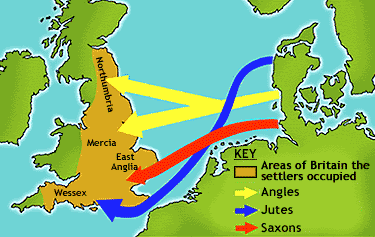
There is now even some evidence that the German influence on Britain may have had a much earlier wave as well. When the grave of the so-called "King of Stonehenge" (dating from about 2300 BC) was opened, he was found to be of Southern German origin:
"Different ratios of oxygen isotopes form on teeth in different parts of the world and the ratio found on these teeth prove they were from somebody from the Alps region," said Tony Trueman from Wessex Archeology.
Germans in more recent times
Tracing the English love of liberty to the ultimately German descent of most of the English population will to many seem colossally perverse in view of Germany's recent experience. Was not Hitler a German and was he not almost the ultimate despot and centralizer of power in his own hands? One could quibble here by saying that Hitler was NOT a German (he was an Austrian) and the Israeli historian Unger (1965) has pointed out that Hitler was much less of a despot than Stalin was but neither of those points is really saying much in the present context.
A very easy way out of this dilemma might be to say that 1500 years of history can make a lot of difference in the evolution of a people. The English could well have retained their traditions of 1500 years ago while the incessant brutalizing wars of Europe could have caused modern-day Germans to have lost their traditions of 1500 years ago. And that could indeed be part of the answer.
Another answer that seems superficially plausible is to argue that the undisputed tendency for the German invaders of Britannia to intermarry with the native Celts produced a hybid population in England that is no longer really German. Recent genetic evidence (See also here and here) does confirm early accounts of intermarriage by showing that modern-day England (as well as Scotland, Wales and Ireland) is still substantially Celtic. So therefore the modern English are not as German as the Germans of Germany. To argue that, however, is to ignore the fact that Germany too has undergone great populations shifts and movements. The Saxons, for instance, were a coastal tribe 1500 years ago but certainly are not that today. So Germans too have undoubtedly intermarried with the more Southerly people into whose lands they moved. And who were the people to their immediate South? Celts! So the population of modern-day Germany too undoubtedly has a strong Celtic admixture -- particularly in the South. Southern and Northern Germans today do tend to see themselves as quite different from one-another. So both modern England and modern Germany are in no sense racially "pure". In both cases we are looking at a diluted ancestral infuence. Different ancestry is not therefore as obvious an explanation for modern day English/German differences as it might initially seem.
The explanation for modern-day English/German differences that I incline towards is that England's freedom from invasions over the last 1,000 years has allowed the English to develop their original Germanic traditions and practices with fewer constraints than those suffered by Germans on the Continent. I would argue that English traditions, practices and values are a more highly evolved version of the same traditions, practices and values that Continental Germans have.
But that, of course only invites more questions: What is the source of those traditions, practices and values? Can traditions and practices survive enormous vicissitudes for over 2,000 years? And if so, why and how? In answering such questions, I think we have to take into account recent findings in behaviour genetics. I think such findings suggest that the common core that both Germans and the English have built upon in developing their traditions, systems, practices and attitudes is in fact their common genetic heritage
There is now ample evidence from twin studies showing that identical twins reared apart are almost as similar to one-another as are identical twins reared together. In other words, genetics accounts for far more of what we are than environment does. And this high degree of genetic influence does extend to ideology. Conservatism is highly heritable (Martin & Jardine, 1986 and Eaves, Heath, Martin, Meyer & Corey, 1999). It seems in fact to be slightly more heritable than stature (i.e. how tall you are). So attitudes and values DO quite strongly tend to be genetically inherited. This clearly does raise the possibility that the original Germanic independence of spirit and respect for individual liberty may have been more than a matter of mere tradition. It may have been genetically encoded.
If that is so, we would expect that the Germans of today, despite the various things that have befallen them in the last 1500 years, might still show at least some residue of that original independence of spirit. I believe that they do. Nobody would argue that respect for the individual is as strong in Germany as it is in England but I believe that some German distinctiveness of the same general kind has persevered right down to modern times. So we need to look at the Hitler episode a bit more carefully at this point and ask whether it might not be exceptional rather than typical in German history -- for all the wartime propaganda to the contrary that one still occasionally hears.
Before we go on to the historical data, however, some psychological data might help plant a few seeds of doubt about the conventional view of Germans: Koomen (1973) showed that prewar Germany did not have characteristically authoritarian child-rearing practices. He concludes:
"Secondary analysis of data concerning periods before and after the war showed that before the war, only differences in parental control with regard to daughters could be demonstrated; parental control concerning sons appeared to be approximately the same in the two countries" [Germany and the U.S.A. (p. 634)].
And one of my survey research reports is perhaps even more surprising. In Ray & Kiefl (1974) I reported that Germans in the 1980s in fact had distinctly "Hippy" values. Could Germans have changed almost overnight from robot-like automations to the exact opposite? It does seem improbable and history helps reinforce the view that Germans have not in fact changed much.
"Kaiser Bill"
The first modern historical fact we need to note is that at the outbreak of the First World War in 1914 Germany was a democracy: And a rather enlightened one at that which took better care of its people than almost any other country at that time did. Wartime propaganda which portrayed the war as the doing of "Kaiser Bill" still lives on but the legal powers of the German monarch were in fact not dissimilar to those of the British monarch. This entry about the Kaiser from the Encyclopedia Britannica is a useful starting point for understanding what actually went on:
William often bombastically claimed to be the man who took the decisions. It is true that the German constitution of 1871 put two important powers in his hands. First, he was responsible for appointing and dismissing the chancellor, the head of the civil government. Admittedly, the chancellor could only govern if he could get a majority in the Reichstag, but this limitation on the emperor's freedom of choice was more apparent than real, because most members of the Reichstag felt it their loyal duty to support whomever the Kaiser appointed. Secondly, the German Army and Navy were not responsible to the civil government, so that the Kaiser was the only person in Germany who was in a position to see that the policy followed by the soldiers and sailors was in line with that pursued by the civil servants and diplomats. Thus, British journalists and publicists had some justification when during and immediately after the war they portrayed the Kaiser as Supreme War Lord, and therefore the man who, more than anyone else, decided to make war.
As time passes, however, historians are increasingly coming to see William as an accomplice rather than an instigator. In the years after 1890 the German upper and middle classes would have wanted a larger say in the world's councils no matter who had been on the throne, and this "urge to world power" was almost bound to bring them into collision with some of the existing great powers. The chief real criticism to be made of the Kaiser is that, instead of seeing this danger and using his influence to restrain German appetites, he shared those appetites and indeed increased them, particularly by his determination to give Germany a navy of which it could be proud. He was a quick-witted, well-meaning man who went with the stream instead of having the vision and strength of judgment to stand out against it.
So the difference between the British and German monarchies was not so much one of different legal powers but of different styles. The Queen is also legally the one who appoints British Prime Ministers and who is head of Britain's armed forces. Just because the British monarch normally does not exercise visible power may create the illusion that he/she has no power but the power is in fact there. This is best shown in Australia, where the royal powers are vested in the Governors and Governors General. These viceroys have in fact twice in the last century exercised their vice-regal powers to dismiss elected governments!
I might add that the Britannica's comment that the German parliament felt duty-bound to support whatever Chancellor (Prime Minister) the Kaiser chose is a gross exaggeration. Even the brilliant Chancellor Bismarck had a lot of trouble with German parliaments. Germany was undoubtedly in 1914 as much a democracy as the Britain it went to war with. And that democracy continued after the war -- so that Hitler himself came to power by essentially democratic means (See here for an extended discussion of that). So a democracy that was interrupted only by the 12 year rule of Hitler is a pretty persistent democracy. Even England had a dictator (Cromwell) for a short period in its history.
Prussia
Those who know their German history, however, will often reply that it is not so much Hitler as his Prussian predecessors who show Germans as not being democratically inclined. The Prussians were the people who created the modern German nation in the first place. Roughly speaking, Prussia is the Northeastern part of Germany which, over the course of the 19th century, gradually came to dominate the whole of Germany. And the Prussian army had a famous tradition of requiring that its troops be Kadaver gehorsam (corpselike obedient) so how that squares with my claim of a Germanic respect for individual liberty does at first seem very difficult to explain indeed.
Perhaps the first thing to note about the Prussians, however, is that they were not originally Germans. They were a Baltic people until conquered by the Teutonic Knights and the Old Prussian (Baltic) language did not die out until the 17th century.
The second thing to note is that the militarized and bueaucratized nature of the Prussian State was largely the the creation of one man -- King Frederick William I, who ruled from 1720 onwards. And although Frederick William was undoubtedly German, he may have been assisted in setting up his militarized State by the large non-German element in his subjects.
Frederick William's son, Frederick the Great (who reigned from 1740), did nothing to undo the efficient bureaucracy set up by his father and made triumphant use of the army created by his father but he was nonetheless notably tolerant and humane. He was hailed by Voltaire (whose model was England) as the "philosopher king" and was noted for instituting freedom of conscience in religious and other matters. As a result, at one time the only place in Western Europe where the Jesuit order was legally permitted was Protestant Prussia. And Voltaire was welcomed in Prussia at times when he was unwelcome in France. So, under Frederick, Prussia was the acme of individual liberty in the continental Europe of the time! An efficient military did NOT mean an oppressed citizenry. Even in militaristic Prussia, the ancient Germanic respect for individual liberty was alive and well and thriving.
So Frederick's Prussia showed that militarism and individualism can coexist. Making it happen is perhaps a difficult trick and perhaps it is a trick that only Germanic peoples can manage but Frederick showed that even extremes of both (for the times) can coexist. It may also be noted that our Anglo-Saxon ancestors were great warriors too but they also still respected individual liberties.
The third thing to note is that rigid obedience to orders was NOT a requirement higher up the chain of command in the Prussian army. The famous Prussian general and military theorist, Clausewitz (1976), is clear that an innovative, flexible, opportunistic, improvisatory strategy is of utmost importance among military commanders. Kadaver gehorsam was, in other words, even in the military context a strictly limited requirement. Germans have always been good military men and the strict obedience to orders of the ordinary soldier is an age-old military ideal. It has no necessary implications for what is true of the society as a whole. The armies of many very different societies have endeavoured to impose such an attitude in their troops -- though probably it is only the Japanese who have ever achieved it.

Perhaps a final potshot at misconceptions about Prussia and Prussian militarism can be found in the reality of the life of a great Prussian general, Helmuth von Moltke, above. A ruthless military robot? Not quite. He was the brilliant strategist and long-time head of the Prussian army who crushed the French at Sedan in 1870. The following is from Wikipedia:
Moltke loved music, poetry, art, archaeology, and theater. He knew seven languages (German, Danish, English, French, Italian, Spanish, and Turkish). He was a prolific artist who filled sketchbooks with landscapes and portraits, as well as a popular author... his account of travels in Turkey, released after his return to Berlin in 1840 and illustrated with his own drawings, turned him into a literary celebrity, a role that he embraced by donning a Turkish and giving public lectures... For all his catholicity of interests, Moltke was no closet liberal. He was a nationalist to the core who was appalled by the liberal revolutions that swept Europe in 1848. He placed his faith in the king and the forces of the old regime.
And a robotic attitude was certainly not true of Prussians generally. Prior to their partial subjugation by another strong figure in German history -- Bismarck -- the Prussian parliament (Yes. They DID have a parliament) was in fact notably liberal (in the 19th century meaning of that term). Though Napoleon himself ran a police State in France, Prussian legislators of the 19th century were influenced by his liberal ideals rather than his authoritarian deeds. As one small sign of that, the emancipation of the Jews was proclaimed in Prussia in 1812. So to mistake Prussian military requirements for the nature of Prussians themselves is a large mistake.
In fact even the great Bismarck himself led a dissolute, disorganized and irresponsible life in his youth that went pretty close to what we now would call "hippy". He did not in fact settle down and begin his rise to power as the "Iron Chancellor" until he married -- at age 32. And he was far from alone in having an early life of a very free-wheeling kind. It could in fact be argued that the old German Wanderbursche tradition and the later Wandervogel movement were long-standing adaptations to and acceptance of hippy values in German youth. So the hippy values of Germans today are not remotely the departure from the past that they might at first seem to those who do not know German history.
Myths about the Third Reich
And, perhaps surprisingly, Prussia was, for all that, closer to being an autocracy with centralized power than was das dritte Reich. The idea that Hitler's Germany was a nation of bureaucratized automatons under a single iron rule exists only in the popular imagination. Any comprehensive history of das dritte Reich (e.g. Shirer, 1964; Bullock, 1964) will tell you that power was if anything excessively decentralized and unfocused under Hitler. Hitler's immense popularity and respect in the country gave him ultimate authority but he exercised it only in a desultory and general way -- leaving most decisions and all administration to his subordinates. And he deliberately gave his subordinates overlapping jurisdictions so that they continually had to compete with one-another for power. Power in Nazi Germany was polycentric, not centralized.
And nor were his subordinates rigid automations. Contrary to the Hollywood stereotype, the Nazi armies were far from being filled with rigid bunglers. Their remarkable initial successes against overwhelming odds (Dupuy, 1986) should alone suggest that but see also Hughes (1986). Both on the home front (Singer & Wooton, 1976) and in the field Hitler's Germany can be shown to be flexible and improvisational rather than rigid and formal.
Hitler's closest friend and the person he spent most time with was Albert Speer (his architect and armaments minister) yet when allied bombers destroyed a building containing most of the records of his armaments ministry, Speer rejoiced at the loss. He welcomed the opportunity to make a new start. He was innovative rather than rigid (Singer & Wooton, 1976). He was an exponent of "some of the most advanced, participative and 'humanistic' management theories being endorsed today" (Singer & Wooton, 1976, p. 79). He called his theory of management "organized improvisation" and he believed in collegial forms of decision-making. He also practised a "loose or fluid manner of structuring organizations" (p. 83). Note that word "collegial" -- meaning that everyone had a say and decisions were collective rather than imposed. So there was Speer right at the heart of power in Hitler's Reich and yet he exercised his power consultatively and with considerable deference to others rather than autocratically. He behaved, in other words, pretty much as Anglo-Saxon kings did 1500 years before him.
And Speer's lack of rigidity and formality was also true of Hitler's generals. It was only their flexibility and creative thinking that enabled them to achieve so much against numerically much superior odds. The example of Rommel is of course well known but a better example is in fact von Manstein -- architect of the Blitzkrieg through France. At the outset of the French campaign, von Manstein faced heavily entrenched French and allied forces that were in no way inferior to the German forces but his bold and innovative Panzer-led strike through the Ardennes outflanked the French forces and routed them completely. And later in Russia, von Manstein destroyed two Russian armies even AFTER Stalingrad. And his conquest of the Crimean peninsula is legendary among military historians: a frontal assault against superior forces who had nearly every advantage: a fortified position, command of the sea, the air, and tanks, while his army had not one tank. So even Hitler's Germany was very much a nation that allowed much scope for creative individualism -- as long as you did not threaten the overall power structure, of course.
The creativity of Nazi Germany can also of course be seen in the large number of innovative weapons systems that it deployed -- cruise missiles, ballistic missiles, radar and jet aircraft. The Focke company also produced the first workable helicopter -- though it was not used militarily. Perhaps most remarkable of all, Nazi Germany successfully deployed precision guided bombs nearly 50 years before US forces first used them to any extent (in the first Iraq war) and the Nazi engineers did it all without benefit of computer technology. And one of the guided weapons concerned -- the amazing Mistel -- had a warhead that would detonate on impact in an explosion that could penetrate 8 meters of steel or 20 meters of ferroconcrete -- which is significant ordnance even by modern standards.
So Hitler's Germany was in fact much more individualistic, original, flexible and decentralized than is generally realized. Unger (1965) has pointed out that Hitler's regime was much less totalitarian than Stalin's. We can now suggest one reason why: Because it was German.
This comparison by Hoppe of the Hitler and Stalin regimes may also be worth noting:
"From 1929 to 1939, in peace time, Stalin and the Bolsheviks killed about 20 million Soviet citizens, for no predictable reason. Hitler and the National Socialists ruined the businesses and careers of hundreds of thousands of German citizens, but the number of people killed by them before the outbreak of the war was only a few hundred, most of them fellow Nazis and all of them for a predictable reason. Even immediately after the onset of the war, when it became known that the Nazis had begun to engage in mercy killings of the incurably insane (euthanasia), the Catholic bishops, led by Bernhard von Galen, openly protested, and German public opinion compelled the Nazis to halt the program. Bishop (later: Cardinal) von Galen survived the Nazi regime. Under Stalin and the Bolsheviks, any such opposition was impossible and Bishop von Galen would have been quickly disposed of."
But perhaps the most important thing to note about the Hitler regime is how shortlived it was -- 12 years. That of course makes it a very poor criterion of what is typically German. All countries have tyrannical episodes. The ferocious despotism of Henry VIII or the oppressive Puritanical rule of Oliver Cromwell in England may be noted as well-known instances of that.
But even if we overlook its very shortlived nature, we see that the Hitler regime does little to challenge the notion of Germans as individualists rather than conformists and we have already seen that militaristic Prussia is a poor challenge to that notion too.
Germany before the Prussian ascendancy
Perhaps the most important thing here, however, is to see things with an historian's eye and realize that recent times in general have been atypical for Germany. Right up until Prussia's ascendancy in the late 19th century, Germany was remarkable for its degree of decentralization. What we now know as Germany was once always comprised of hundreds of independent States (kingdoms, principalities, Hanseatic cities etc.) of all shapes and sizes: States that were in fact so much in competition with one another in various ways that they were not infrequently at war with one-another.
Like many other groups, however, Germans encompass a wide variety of subgroups within their ranks and Prussians are one such subgroup. Prussia, however is only one part of Germany and in fact for most of its history it was only partly German -- including large numbers of Poles, Silesians and other non-Germans. Furthermore, the Prussian ascendancy was also both very recent and very short-lived. It dates essentially from the French surrender at Sedan in 1870 and ended with the flight of the Kaiser to Holland in 1918 -- to be succeeeded by the very un-Prussian Weimar Republic. Those 48 years are undoubtedly of enormous significance to the world but all that they show essentially is that Prussian militarism had some initial success but ended up destroying itself.
Prior to Sedan, Germany was a disunited and decentralized agglomeration that generations of Prussians, French and others tried unsuccessfully to subdue. And after Sedan, unity of a sort was achieved and maintained only by the diplomatic genius of Bismarck. And even with the armed might of Prussia behind him even Bismarck had a lot of trouble with the other German States. He could not even get his Prussian monarch declared as being "Emperor of Germany". He had to make do with "German Emperor" as a title. And even Bismarck was not able to shake the independence of the Germans in the Austrian lands. He had to be content with them as not always reliable allies.
And after the remarkable restraint provided by Bismarck was dispensed with by the new Kaiser (Wilhem II or "Kaiser Bill"), the German Empire very quickly self-destructed. We know it as World War I. And Hitler's attempt to revive it went the same way.
So now Germany is back to something much more like what it always was -- a nation with a strongly decentralized power structure in the form of the various Land (State) governments. And that is of course exactly the same structure that certain other countries of mainly Germanic origin (the USA, Canada and Australia) have adopted too -- a system of State governments which markedly limits central (Federal) government power. And it might be noted that "devolution" is rapidly leading to a similar state of affairs in Britain itself. So the German origins of the English do make their historic dislike of concentrated power at the Centre just one part of a larger picture.
To summarize the main points of what has been said so far about recent German history:
1). Germany has historically been notable for its decentralization of power and is still relatively decentralized today.
2). The Prussian hegemony of Germany and the Nazi domination of Germany were both relatively short-lived (48 and 12 years respectively) by comparison with a history of Germany that stretches back for over 2000 years so cannot by themselves be the basis for much in the way of generalizations about Germans. We might as well argue from the despotism of Henry VIII (38 years) or the Cromwellian Protectorate (6 years) that Englishmen do not value their liberties.
3). Although both Prussia and Nazi Germany undoubtedly had strong autocratic features, that is far from the whole story. Both kings and parliaments of Prussia were in fact for much of the time remarkably liberal (in the original 19th century sense of that term) by the standards of their day and Nazi Germany also was remarkably polycentric in its power structure. So even these "worst case" regimes still retained much of the ancient German diffused power structure that the Anglo-Saxons brought with them to what became England.
For another treatment of the Germanic role in the evolution of Anglo-Saxon liberty see a wide-ranging article by Razib. He agrees with my contention here that Germanic origin maps respect for the individual a lot better than the prevalence of Christianity does.
And it was of course only the fractionated and competing centres of power existing in mediaeval Germany that enabled the successful emergence there of the most transforming and anti-authority event of the last 1000 years: The Protestant Reformation. Despite the almost immediate and certainly widespread popularity of his new teachings among Germans, Luther ran great risks and would almost certainly have been burnt at the stake like Savonarola, Hus and his other predecessors in religious rebellion had it not been for his (and our) good fortune that he was a Saxon. His Prince, Frederick III ("The Wise") of Saxony gave him constant protection. As one of the Electors of the Holy Roman Empire, Frederick was strong enough and independent enough to protect Luther from Pope, from Emperor and from other German potentates.
And the example of Luther highlights why decentralization of power is important: It introduces diversity. In theory, there is no reason why a set of decentralized mini-states cannot all be despotic. So decentralization is not necessarily a good thing in and of itself. It is good because of what it leads to. And what it leads to is choice. And where there is choice people can vote with their feet. A ruler that is too despotic will simply lose "subscribers" (citizens). His population will tend to decamp and put themselves under a less tyrannical ruler next door. So the power of any one ruler is constrained by the knowledge that his more valuable citizens in particular have an "out" if he shows too little consideration of them. And this was true of course not only in Germany for most of its history but also in Renaissance Italy. Especially skilled individuals such as Bach, Haendel or Leonardo did change rulers from time to time in a search of a better deal for themselves.
As it happens, however, both in Tacitus and in accounts of the politics of the early Anglo-Saxon kingdoms of England, we do see a picture of power that is not only decentralized but also power that is exercised consultatively. And that connection is of course far from automatic. As we see in the case of Prussia and in the case of some of the Italian city-states, this is not always or necessarily so. Decentralized power can still be power that is exercised in a highly undemocratic way. But decentralized power IS fractionated power and the tendency for fractionation to exist not only between states but also within states is obviously strong. This is shown not only in the Anglo-Saxon case but also in the case of the Italian city-States of the renaissance -- many of which (such as Venice) were republics. Italy, however, is perhaps a case where independence of mind is excessive. Italian government to this day is chaotic. The Germanic people are the ones who seem to have struck a balance between individualism and the ability to accept discipline when required.
Some extracts from a review of The Gifts of Athena: Historical Origins of the Knowledge Economy (2002) by Northwestern University economist Joel Mokyr reflect a similar view of how the technological and social evolution that created the modern world depended critically on individualistic groups who were able to express their individuality because of the decentralization of North-Western Europe.
"The rate of technological development has been deeply affected by the fact that people who studied nature and those who were active in economic production have been, through most of history, by and large disjoint social groups." ....
Eighteenth century Europe also fractured into many independent sovereignties at the conclusion of the religious wars that had wracked continent for the previous two centuries. This political diversity promoted greater freedom of thought among merchants, scientists, and other thinkers, who would often simply pick and up leave if the government of one place displeased them. ....
Those who still doubt that there is any connection at all between decentralization of power and individual liberty might reflect on the Magna Carta. It is rightly regarded as the founding document of English liberty and democracy and yet it was signed only because the decentralized power of the barons forced it to be signed.
"Germanic", "Teutonic" and the Jews
Most readers should by now be feeling a bit dubious about my line of argument. Is what I am saying not reminscent of Nazi doctrines of German racial superiority? Am I not attributing at least one type of superiority to Germans just by reason of their being German?
In response I have to say that I have been a student of the Nazi phenomenon for most of my adult life and have even written several papers for Jewish journals about it but I still do not know what Hitler thought to be historically Germanic -- other than that it was martial and pagan. On my reading he had no clear idea of it at all: Just confused and contradictory utterances from time to time. As "Robert Locke" pointed out in the August 28, 2001 issue of "Front Page" magazine, Hitler was in fact much more vocal about being Aryan than being Germanisch. So it is difficult to show that my ideas are dissimilar to Hitler's without knowing exactly what his ideas were. His speeches are raves rather than anything logically consistent (though they did, of course, have great emotional consistency).
I guess, however, that the one lesson he would NOT draw from German history is precisely the one that I DO draw: That the German spirit is inimical to tyranny and in favour of individual liberty. I think it is fairly clear at least that individual liberty was not one of his priorities. The Nazi Fuehrerprinzip (leadership principle) was in fact diametically opposed to individualism of any sort. So does not my view of what is Germanic make me precisely ANTI-Nazi? I think it does.
But why should I even try to make such distinctions between my arguments and Hitler's? I do not really see why a rational debate should be distracted by irrelevant comparisons with a populist demogogue. On the other hand, I do not like to give needless offence so I am making this clarification.
Actually, I should probably have been using the word "Teutonic" instead of "Germanic" as it is clear that everything I have so far said about the Anglo-Saxons is equally true (if not more so) of the Scandinavians. Those Vikings were certainly an individualistic, independent and decentralized lot! They also treated women more or less as equals and have a great history of democracy. The oldest continuously sitting parliament in the world is in fact the Althing of Iceland -- with a history going back 1,000 years. And Scandinavians are almost 100% Protestant too -- which fits with a spirit of independence and individualism.
As to Jewry, I no more believe in Jewish conspiracy theories than I believe in the man in the moon. I will leave such beliefs to the simple-minded of both political extremes. I am and always have been, however, an unapologetic and unreserved supporter of Israel. But I hope nonetheless that I have the sort of balanced view of the Jews that one should have of any group -- seeing both strengths and weaknesses. I think that Jews in general are a remarkable and admirable people but I do not think that they are right about everything and I think that their historic collectivist doctrine that they are a "chosen people" has been both a blessing and a curse to them.
And insofar as Christians have adopted such "groupthink" it has been a dubious influence among them too. Fortunately, St. Paul (a Jew) initially set Christianity on a much more inclusive path (Romans 2: 25-29; 1 Corinthians 7: 18,19; Galatians 3: 26-29; Colossians 3:11) than that adopted by Jews before him so group consciousness has not had such good precedents among Christians. The way both Catholics and Protestants have engaged in persecution of those not of their faith does however show that religious groupthink is far from absent among Christians.
Interestingly, both modern Jews and ancient Jews have always been fractious and disunited so Jews could be an inspiration to those who OPPOSE collectivist thinking if we looked at what they did rather than what their religion preaches!
Protestantism versus Catholicism
Luther has been mentioned as a beneficiary of Germanic power decentralization but Luther's message received wide acclaim in Germany generally so it seems reasonable to say that German distrust of centralized power not only protected Protestantism but was was in fact a major cause of Protestantism. Because what is Protestantism after all if it is not a rejection of centralized religious authority? So in that sense, conservatism and Protestantism are twin children of Germanic suspicion of centralized power.
Looking at it another way, we could say that Protestantism is the Germanic form of Christianity and that conservatism is a political expression of religious Protestantism. There always have been, however, many forms of Protestantism and some forms (e.g. the Puritanism of England during the time of Cromwell's Protectorate) were very restrictive of individual liberty.
Further, where the Roman Catholic believes that the sacraments administered by a religious authority (a priest) are essential for his ascent into heaven, the Protestant believes that he can commune with the Almighty directly. Catholicism fosters habits of submission to authority whereas Protestantism inculcates hardy independence. So acceptance of government authority over oneself should come as naturally to the Catholic as it is alien to the Protestant.
So German history could at a pinch be seen as a struggle between native decentralizing tendencies and Catholic centralizing tendencies --- with the (more Celtic) German lands closest to Rome remaining Catholic and Imperial while the (Northern) German lands farthest from Rome remained independent, Protestant and decentralized. And the struggle the North had to resist the Imperial South was indeed a titanic one --including the famous 30 years war from 1618 to 1648.
As some evidence that there is still something left of that difference, it might be noted that, in interwar Germany, the Protestant North was largely "Red" (revolutionary) whereas the Catholic South was largely Nazi -- i.e. more prepared to operate within the existing power structures and more prepared to accept the Church. Hitler did after all have a Catholic education.
So how do we account for the fact that "Christian Democratic" (i.e. Catholic) political parties seem generally to be the major conservative forces within modern European politics? And how indeed do we account for the fact that at least 50% of Germans are to this day Catholic?
A essential part of the answer is of course the counter-reformation -- a process that began in response to Luther and which restored the acceptabity of Catholicism to many Germans. This reform process within the Catholic church may have begun in response to Luther (though Luther had precursors) but has in fact been an ongoing process within the Catholic Church ever since --- with the relatively recent Vatican II ecumenical council being a particular highpoint of the process. So the Catholic church could only combat the power of Luther's message by partially bending to it and thus becoming itself to a large degree Protestantized and weakened in authority. And the way a huge proportion of otherwise convinced Catholics now disregard the teachings of their church on such matters as contraception shows vividly that the authority of the Church is now in fact mostly an empty shell.
So in various guises Germanic Protestantism has won the day over Roman authority in the religious sphere just as Germanic conservatism has won the day over socialism in the political sphere. We now have Protestantized Catholics and "Thatcherized" socialists in much of the world.
Nonetheless, even in a weakened form, the Catholic church offers a model of "top down" social organization that must make it easier for Catholics to accept political arrangements of a "top down" sort. If you look up to the Pope as an essential part of your salvation in the spiritual sphere, to look up to the government as an essential agency in securing your material wellbeing is surely only a small step. So the fact that the vast majority of Europeans are still Catholic (even if the Catholicism is much watered down from what it was) should make Europeans more accepting of all-pervasive government than Anglo-Saxons would ever be. And so, of course, it has come to pass. In Bismarck, Hitler, Mussolini, Franco, Salazar, Horthy, Pilsudski, Antonescu and Papadopoulos, Europe has had authoritarianism in government on a scale unknown in the English-speaking world. And we don't need to mention Stalin and the Russian Orthodox "Third Rome".
So how conservatism has evolved in the modern-day English-speaking world is rather different from how conservatism has evolved in Europe. Anglo-Saxon conservatism benefited greatly from Henry VIII, who made England almost totally Protestant. Protestants in Germany failed to achieve this dominance and so England has been better able to stay close to its Germanic and Protestant roots -- whereas European conservatism has never totally escaped Catholicism. European conservatism has therefore mostly lost its anti-centralization principles and conforms much more closely to the stereotyped image of conservatism as being merely a defence of traditional arrangements generally. This of course makes it a much weaker form of conservatism and the huge bureaucratization that now characterizes the European Union is vivid evidence of that. European conservatives have been much less effective as opponents of big government because opposition to big government is much less of a central position for them.
Scotland, liberty and the creation of the modern world
My sole focus in discussing the Germanic tradition so far has been on individual liberty. There are however other ways in which Germanic and Protestant civilization is often alleged to have played a leading role in shaping the modern world. In particular, the German reformation is seen as enabling a freedom of thought that eventually brought about the English industrial revolution and hence modern civilization as we know it. And as part of that process the scientific technical and engineering innovations that enabled the modern world do almost all seem to have flowed from Germanic countries -- principally Germany itself and Britain. From the printing press to the steam engine the creation of technological civilization seems to have flowed almost entirely from the Germanic peoples of Northwestern Europe.
I think that there is a large element of truth in this account but do not place any great reliance on it. It seems to me that the account overlooks very substantial contributions from France and Italy for a start (e.g. Marconi, Pasteur etc.) -- though it could also be argued that both the Northern French and the Northern Italians have substantial German elements (e.g. the Franks and the Lombards) in their ancestry.
Another objection is the role of the Scots. In his book How the Scots Invented the Modern World, Arthur Herman points to the very substantial contribution made by Scots to the the development of modern Western thinking and the invention by Scots of much in modern Western technology. So how does that square with the contention that the modern world was essentially a Germanic invention? Surely the Scots are Celts rather than Germanic!
I doubt however that the Scottish case constitutes a crucial objection. Some reasons why:
* To my knowledge both the Chinese and the Russians make similar claims to have produced many great inventions. Most things seem to have had more than one "inventor"
* There is an awful lot that the Scots did NOT invent -- from the printing press onwards.
* The Scottish lowlands (where most Scots live) were thoroughly colonized by the Anglo-Saxons so most Scots have substantial Germanic ancestry.
* The Celtic Scots got at least Germanic culture via Protestantism and the English hegemony generally.
The reviews in the Amazon site linked above are well worth a read.
On the political front however, the Scots show very clearly the Germanic difference. Scotland has long been heavily socialist, returning very few Tory members to the Westminster parliament. When English voters swung very heavily towards Margaret Thatcher in 1979, Scotland actually swung away from the Tories! So the greater Celtic element in the Scots ancestry does seem to make a marked difference in politics. Where the Germanic English favour individualism and conservatism, the Celtic Scots favour collectivism and socialism.
I have more on the Scots here and here
Full citation details for all references given above can be found here.
FINIS
Subscribe to:
Posts (Atom)